
Our curriculum map links and home learning ideas:
ENglish
Please select a year group
Please click here for Year group spelling lists
Year Three
Accordion content
Year Four
Accordion content
Year Five
Accordion content
Year Six
Accordion content
French
Please select a year group
Year Three
|
Autumn – French Greetings |
|
|
Overview |
In this unit, children will use puppets to practise a variety of French greetings and learn how to introduce themselves. They will also understand how to choose the correct greeting based on the time of day and ask someone how they are. |
|
Career/Mantle and Spirituality |
Children explore the role of a puppeteer during this unit of work. They design and create a finger puppet (paper, card) and use this to perform using the different greetings they have learnt. Children are reminded that greetings are more than just polite words—they’re a form of connection, respect, and recognition of others' presence, which resonates with many spiritual traditions. This is reflected in the Bible verse: 3 John 1:14 "...Peace to you. The friends here send their greetings. Greet the friends there by name." Questions to consider: • How can we get to know God? • Do you think greetings can change someone's day? Why? • What does it mean to greet someone “from the heart”? |
|
Key vocabulary |
Bonjour, salut, au revoir, bonsoir, bonne nuit, ça va bien, ça va mal, c’est..., comment tu t’appelles ?, je m'appelle..., non, oui |
|
Pupils will be assessed through: |
At the end of this unit, children will participate in a puppet show performing a rhyme in French, consolidating the greetings learnt over the unit. |
|
Previous skills and knowledge to be revisited |
In Key Stage 1, there is no programme of study for French. This unit, French Greeting, introduces children to French.
|
|
Optional home learning |
This website will help children to consolidate their understanding of different greetings in French French Greetings - Match up (wordwall.net) |
|
Spring – Adjectives of colour, shape and space |
|
|
Overview |
In this unit, children will describe shapes using adjectives of colour and size. They will learn the position of adjectives relative to the noun; identify cognates, practise language skills and develop confidence through games and creating animal artworks. |
|
Career/Mantle and Spirituality |
Children explore the work of artists, to create their own piece of art in the style of Matisse labelling it in French. This unit allows children to consider values like awe, creativity, identity, and appreciation of difference. Exploring how objects are describes provides children with the opportunity to reflect on how everyone is uniquely and beautifully made. This links to the Bible verse: “Yet you, Lord, are our Father. We are the clay, you are the potter; we are all the work of your hand.” Isaiah 64:8 reminding us symbolically about form and shape, showing how God shapes our lives like a potter forms clay. Questions to consider: • What do you think a colour might feel like? Is blue always sad or can it be peaceful too? • Do our favourite colours say something about who we are? • Do things change colour, shape, or size when we look at them with love? • Do some shapes feel soft and friendly, while others feel sharp or scary? |
|
Key vocabulary |
Rouge, bleu, jaune, vert, orange un cercle, un triangle, un carré, un rectangle, grand, petit, c'est |
|
Pupils will be assessed through: |
At the end of this unit, children will create their own picture in the style of Matisse. Using animals as the focus for the pictures, children will use shapes of varying sizes and colours to represent the animals. |
|
Previous skills and knowledge to be revisited |
Children will build on listening and responding to single words and short phrases and practising speaking with a partner. They will also know that consonants at the end of words in French are not usually pronounced: the ‘t‘ is silent in salut, comment, petit and vert. |
|
Optional home learning |
This website will help children to consolidate their understanding of colours in French French- Colours - Labelled diagram (wordwall.net) |
|
Summer – Playground games and classroom |
|
|
Overview |
In this unit, children learn to count in French from one to twelve including recognising the written number. They ask how old someone is and answer the same question, comparing sentence structures in French and English. They also learn the vocabulary for classroom items and begin to understand that every French noun is either ‘masculine’ or ‘feminine.’ |
|
Career/Mantle and Spirituality |
Children become children’s birthday card designers. Focusing on 1 to 12-year-olds, children use their knowledge learnt in the unit for numbers in French to design birthday cards. As well as this, children become visual merchandisers (shop window designers) they will design a new shop window display for ‘Back to School’ equipment at a local shop. Children are reminded of the idea of gratitude — being thankful for the tools that help us learn. This is reflected in the Bible verse: Psalm 90:12 – “Teach us to number our days, so we can grow wise.” Which reminds us that every day is a gift from God and when we learn to count and talk about our age, we can think about how we’re growing in kindness, learning, and love. Questions to consider: • What makes a good leader in a game? • Why do we have rules in school?
|
|
Key vocabulary |
Un, deux, trois, quatre, cinq, six, sept, huit, neuf, dix, onze, douze un crayon, un taille-crayon, un stylo, un cahier, un sac, une règle, une gomme, une trousse, des ciseaux, j’ai, je n’ai pas, tu as…? |
|
Pupils will be assessed through: |
At the end of this unit, children will be assessed by creating a birthday card. They will present their card to the class stating the age and colours used, reinforcing the vocabulary learned. Children will also design a shop window display stating the school equipment learned throughout the unit of work. |
|
Previous skills and knowledge to be revisited |
Children will understand and notice cognates and near cognates. They will use visual clues to make predictions about the meaning of unfamiliar vocabulary. This unit will enable them to build confidence by repeating short phrases with increasing accuracy and recognise that sounds and spelling patterns can be different from English. Children will understand that every French noun is either masculine or feminine and that most adjectives are placed after the noun in French.
|
|
Optional home learning |
This website will help to consolidate your child’s understanding of classroom equipment in French French classroom objects - Teaching resources |
Year Four
|
Autumn – Portraits |
|
|
Overview |
In this unit, children learn adjectives for describing people’s physical appearance and their personality. They create simple sentences ensuring that the adjectives agree with the gender of the noun. |
|
Career/Mantle and Spirituality |
Children explore the role of cartoonists during this unit of work. They create their own cartoon character based of their own appearance and use adjectives for description of appearance and personality. Children are encouraged to spiritually think about appearance, reflecting deeply on how they see themselves and others—not just physically, but through the lens of inner worth, purpose, and sacred identity. This is reflected in the Bible verse: “So God created man in his own image...” (Genesis 1:27) Questions to consider:
|
|
Key vocabulary |
il a/elle a, il est/elle est, heureux/heureuse, sérieux/sérieuse, les cheveux, les yeux, petit/petite, grand/grande, il s'appelle..., elle s'appelle..., blond(e)(s), noir(e)(s) |
|
Pupils will be assessed through: |
At the end of this unit, children will be assessed by creating a portrait of a character, children will label the features of the character using the vocabulary learned throughout the unit. |
|
Previous skills and knowledge to be revisited |
Children will continue to build confidence from year 3 by repeating short phrases with increasing accuracy. They will select and write short words and phrases and Identify and discuss cognates and begin to explore various language detective strategies.
|
|
Optional home learning |
This website will help children to consolidate their understanding of describing faces in French Learn Describe faces in French for primary with Mix and match game (french-games.net)
|
|
Spring – Number, calendars and birthdays |
|
|
Overview |
In this unit, children learn French numbers 1-31, the days of the week, months of the year, dates and seasons through maths and songs. |
|
Career/Mantle and Spirituality |
Children take on the role of event organisers. In this role they will, create an invitation (poster) advertising the school Spring Easter celebration stating: day, date, month, year and season. This unit encourages children to consider each day as a fresh beginning and an opportunity to live with intention, mindfulness, or in alignment with divine purpose. This is reflected in the Bible verse: “This is the day the Lord has made; let us rejoice and be glad in it.” – Psalm 118:24 which reminds us of being present in the now. Questions to consider:
|
|
Key vocabulary |
Onze, douze, treize, quatorze, quinze, seize, dix-sept, dix-huit, dix-neuf, vingt, vingt-et-un, trente, un anniversaire |
|
Pupils will be assessed through: |
At the end of the unit, children will be assessed by choosing appropriate vocabulary to explain how old they are, when their birthday is and the season it falls in. |
|
Previous skills and knowledge to be revisited |
Children will begin to notice common spelling patterns and recognise that sounds and spelling patterns can be different from English. Children will recall that ‘h’ at the start of a word in French is not pronounced.
|
|
Optional home learning |
This website will help your child to consolidate their understanding of numbers in FrenchFrench Numbers - Teaching resources |
|
Summer – Weather and the water cycle |
|
|
Overview |
In this unit, children learn phrases to describe the weather and vocabulary for the compass points. They count from 1-100 in multiples of ten and combine this knowledge to make statements about what the temperature is in different parts of France and to deliver a weather forecast. |
|
Career/Mantle and Spirituality |
Children explore the role of meteorologist. They role play in French reporting on the weather before updating the school community via William Ford Radio. In this unit, children can see weather as awe and wonder of nature. It allows children to reflect on the power and beauty of weather in the world. Children can explore how rain nurtures life, how storms demonstrate nature’s force, and how sunshine lifts moods. This is reflected in the Bible verse: Acts 14:17 "But he has given proof of what he is like. He has shown kindness by giving you rain from heaven. He gives you crops in their seasons. He provides you with plenty of food. He fills your hearts with joy." This reminds us that rain is a gift from God to help things grow and give us food. Questions to consider:
|
|
Key vocabulary |
il fait beau, il fait mauvais, il fait chaud, il fait froid, il pleut, il neige, il y a du soleil, il y a du vent, le nord, le sud, l'est, l'ouest |
|
Pupils will be assessed through: |
At the end of the unit, children will create a brief weather report stating the recent weather and temperature in the local area. |
|
Previous skills and knowledge to be revisited |
Children will recognise some familiar French words when written in a short phrase and how intonation and gesture are used to differentiate between statements and questions. They will also and begin to predict key word patterns and spellings.
|
|
Optional home learning |
This website will help your child to consolidate their understanding of weather in French French Weather - Teaching resources |
Year Five
|
Autumn – Space Exploration |
|
|
Overview |
In this unit, children develop listening and language detective skills through a space theme. They use figurative language and develop sentence structure by adding adjectives and prepositions; they also make simple adjectival comparisons. |
|
Career/Mantle and Spirituality |
Inspired by the global effort of space exploration and French being one of the official languages of the European Space Agency (ESA), children will learn space vocabulary to simulate being part of an international space mission team. Children will record a verbal message describing the planets seen from space on a recent mission. They unit of work, enables children to reflect on life’s big questions, awe and wonder, and our place in the universe. It allows children to consider the concept of infinity and discuss how space has no end, and how that idea can relate to spiritual ideas of the infinite or eternal. This is reflected in the Bible verse: The God said, “Let there be lights in the expanse of the heavens to separate the day from the night, and let them be for signs and for seasons and for days and years.” Genesis 1:14 Questions to consider:
|
|
Key vocabulary |
le Système solaire, le Soleil, la Lune, la Terre, une planète, l’espace, plus ... que, moins ... que, grand, petit, chaud, froid |
|
Pupils will be assessed through: |
At the end of the unit, children will be assessed on describing a planet using the correct noun/adjective agreement. |
|
Previous skills and knowledge to be revisited |
Children will recap identifying key information in simple writing and use a range of language detective strategies to decode new vocabulary. They will speak and read aloud with increasing confidence and fluency and know that a change in voice intonation can indicate when a question is being asked.
|
|
Optional home learning |
This website will help children to consolidate their understanding of using adjectives in French French lessons to learn primary Grammar - adjectives 1 free (french-games.net) |
|
Spring – My family |
|
|
Overview |
In this unit, children are introduced to family and relations vocabulary. They also learn the possessive adjective- my, and how to express likes and dislikes. Work builds on from previous units as children describe members of a family including: their looks, their ages, their birthdays and their likes and dislikes. |
|
Career/Mantle and Spirituality |
Children take on the role of a genealogist, exploring family trees and naming family members. This unit enables children to develop a better understanding of themselves by reflecting on their own family and who is important to them. They learn to appreciate and respect different cultures by exploring similarities and differences in families. This is reflected in the Bible verse: Ephesians 4:32 Questions to consider:
|
|
Key vocabulary |
mon frère, ma sœur, fils/fille unique, mon père, ma mère, mes parents, mon grand-père, ma grand-mère, mon oncle, ma tante, mon cousin, ma cousine |
|
Pupils will be assessed through: |
At the end of this unit, children will plan, prepare and present a brief presentation describing their family. |
|
Previous skills and knowledge to be revisited |
Children will recap identifying key information in simple writing and speak in full sentences using known vocabulary. They will also understand that words in French and English will not always have a direct equivalent in the other language.
|
|
Optional home learning |
Encourage your child to share the new vocabulary learnt in French naming family members in French. The following website contains activities and videos linked family: KS2 French - BBC Bitesize |
|
Summer – Shopping |
|
|
Overview |
In this unit, children learn to construct high numbers in French. They develop food-related vocabulary through games, stories and role-play and build on their understanding of sentence structures, questions and phrases, equipping themselves with language they could use when shopping in France. |
|
Career/Mantle and Spirituality |
Children take on the role of shop owners/assistants. In this role they will, price items for a shop and use Euros to make purchases. They will build on French greetings to interact with customers and exchange money. This unit allows children to consider different values including: gratitude (for what we eat), mindfulness (in eating and choosing food), generosity and sharing meals, respect (for our bodies, others and the planet) and cultural appreciation (how food connects communities). This is reflected in the Bible verse: Matthew 6:11 – "Give us this day our daily bread." Which reminds us to be thankful for the food we have each day — a powerful reflection when learning about buying and preparing food. Questions to consider:
|
|
Key vocabulary |
Trente, quarante, cinquante, soixante, soixante-dix, quatre-vingts, quatre-vingt-dix, cent, ça fait ..., c’est combien ? |
|
Pupils will be assessed through: |
At the end of the unit, children will create their own brief story in the style of M.Mangetout (lesson 3) building on the vocabulary learned throughout the unit. |
|
Previous skills and knowledge to be revisited |
Children will use a range of language detective strategies to decode new vocabulary including context and text type and use intonation and gesture to differentiate between statements and questions. |
|
Optional home learning |
This website will help children to consolidate their understanding of using food and shopping in French French lessons to learn Groceries for primary learners |
Year Six
|
Autumn – French Sport and the Olympics |
|
|
Overview |
In this unit, children learn that conjugating the verb aller – to go means recognising it in different forms. They identify correct prepositions as well as learn sports vocabulary. |
|
Career/Mantle and Spirituality |
Inspired by a range of Olympic sports, children will explore Olympic and International Sports Careers. They will focus on roles involved in competing as an athlete, supporting as a coach and sports officials and referees. They will learn about international events where French is an official language and how multilingual communication is useful. This unit enables children to recognise the values of spiritual development The Olympic Games promote, such as: respect (for others, different cultures, and rules); excellence (striving to be your best, which can be linked to personal growth and self-discipline) and friendship: unity among nations, showing empathy and understanding across cultures. This links to the Bible verse, 2 Timothy 2:5 “An athlete is not crowned unless he competes according to the rules.” Questions to consider:
|
|
Key vocabulary |
le sport, je joue, je fais, le football, le basketball, le tennis, le rugby, le ski, la boxe, le gymnastique, la natation, le tir à l'arc, le skate, j'aime, j'adore, je déteste |
|
Pupils will be assessed through: |
At the end of this unit, children will be assessed by writing a brief paragraph about the Olympic Games stating: duration of the games; start and end date; sports competed in and countries which participate. |
|
Previous skills and knowledge to be revisited |
Children will read and use language detective skills to assess meaning including context, text type and sentence structure. They will use a bilingual dictionary to select alternative vocabulary for independent sentence building and speak in full sentences using known vocabulary.
|
|
Optional home learning |
This website will help children to consolidate their understanding of different sports in French SP French sports - Find the match (wordwall.net) |
|
Spring – French Football Champions |
|
|
Overview |
In this unit, children practise language-learning strategies and develop reading, speaking and listening skills through a football-related theme. They learn how to respond to questions about football players and write football player profiles in French. |
|
Career/Mantle and Spirituality |
Children explore the role of a sports commentator/ journalist. They will understand how the roles: report on football matches in French-speaking countries and interview players, write match reports, or appear on TV. This unit allows children to understand how sport connects with personal values, community, identity, and deeper meaning beyond physical activity. Children can explore belonging and identity as football brings people together across cultures and languages. This is reflected in the Bible verse: Two are better than one because they have a good return for their labour. For if either of them falls, the one will lift up his companion. But woe to the one who falls when there is not another to lift him up. Ecclesiastes 4:9-10 which reminds children on how being part of a team or supporting a team can create a sense of identity and belonging. Questions to consider:
|
|
Key vocabulary |
le ballon, le but, le sifflet, le terrain, marquer un but, mi-temps, sauver un but, un carton jaune, un carton rouge, une équipe, un match de foot, un footballeur/footballeuse |
|
Pupils will be assessed through: |
At the end of this unit, children will create a footballer player profile in French. This will include: name, age, nationality, team name and position played. |
|
Previous skills and knowledge to be revisited |
Children will use further contextual clues and cues, such as awareness of grammatical structures to deduce unknown vocabulary. They will speak and read aloud with increasing confidence and fluency and use intonation and gesture to differentiate between statements and questions. Childre will also know whether to use the pronouns il ‘he’ or elle ‘she’ when describing someone.
|
|
Optional home learning |
This website will help children to consolidate their understanding of sport and countries in FrenchFrench lessons to learn Sports for primary pupils free (french-games.net)
|
|
Summer – Visiting a French Town |
|
|
Overview |
In this unit, children learn directional, transport and town vocabulary together with prepositional phrases. They describe their journey to school, plan a trip to France and become tourist guides, giving reasoned opinions on which places in town to visit. |
|
Career/Mantle and Spirituality |
Children explore the role of a tour leader. They will understand how this role shows/guides people around cities and use French to talk to local businesses, hotels, and visitors. Exploring new places helps us grow in understanding, wonder, and connection with others. In this unit, children can gain a sense of wonder and curiosity. Spirituality grows when we are amazed by how different and beautiful the world can be. The Bible verse: “Love your neighbour as yourself.”— Mark 12:31 encourages kindness, respect and care when learning about different people and places. It reminds us how we show hospitality, friendship, and interest in others. Questions to consider:
|
|
Key vocabulary |
en voiture, en bus, en train, en avion, à vélo, à pied entre, autour de, au bord de, loin de, la droite, la gauche |
|
Pupils will be assessed through: |
At the end of this unit, children will create a tourist leaflet, in French, for their own local area. |
|
Previous skills and knowledge to be revisited |
Children will recap listening and understanding information from an extended audio passage using language detective skills. Developing extended sentences to justify a fact or opinion. To know that parce que (because) can be used to extend a sentence and give a justification.
|
|
Optional home learning |
This website will help children to consolidate their understanding of French Towns in French French Places in town - Teaching resources |
Other curriculum information
Our curriculum intent applied to language and literacy:
|
Our school intent |
How we apply this in Language and Literacy |
|
To be successful:
|
The English curriculum enables children with the opportunity to read and look in depth at a wide range of genre books linking to the foundation curriculum. For example: Revolt against the Romans linking to the Year 4 History Romans unit; James and the Giant Peach linking to the Year 3 PSHE unit ‘celebrating differences’; Hidden Figures linking to the Year 5 space unit in science and Street Child in Year 6 supporting their history unit on The Victorians. English lessons provide children with opportunities for written and spoken outcomes of lessons. Across units of work, there is coverage of drama, role play debates across the curriculum. Each unit of work builds towards the children creating an end piece of writing for a range of different purposes and genres. Lessons are recorded in a variety of ways, having written outcomes and oral work being presented through photographs and videos displayed using QR codes. The English curriculum overviews outline learning objectives and success criteria; providing a structure and outcome to each lesson. Knowledge and skills are consolidated throughout Key Stage 2 applying grammatical terms and writing skills to a range of writing purposes. Children are encouraged and supported to develop their vocabulary and language in both written and spoken tasks; this is prompted through the online resource ‘Widgit’. This enables children to have visual support through symbols, giving visual meaning to words. Curriculum overviews are adapted and personalised for children to assist them in working parallel to their peers. Shared reading enables discussions and book talk through adapted questioning, allowing all children to develop the love for reading. |
|
To be healthy:
|
Children are given the opportunity share and discuss their opinions and thoughts on what they are reading. World Book Day encourages children to celebrate reading and the joy it brings each other. Shared Reading lessons provide children with the opportunity for book talk, where they can form and discuss their opinions on characters actions and events. Within English, children are encouraged to share their ideas and thoughts on during discussions and debates. During themed days such as: Vision, Values and Spirituality, children have the opportunity to express their thoughts and beliefs through a range of writing purposes. These range from poetry, (shape, acrostic, diamante and kennings) political speeches and manifestos, pledges, recounts, summaries and leaflets. In year 6, children use their knowledge from their geography unit on ‘Mountains’ to write a balanced argument on whether ‘Should tourists be allowed to climb mountains’ as well as focusing on the geographical reasons, children also explore the physical and mental health benefits this can bring. |
|
To be fulfilled:
|
We provide children with excursions to France; this opportunity enables children to experience a new culture and apply and practise their oracy skills in speaking with locals. As part of the Year 5 curriculum, children visit a West End show, for instance Matilda and Frozen. This enables children with the opportunity to see a story brought to life on stage and see first-hand other roles and responsibilities linked with theatre and production. The Year 3 and 4 curriculum sees children explore instructional writing; building on skills and following their own instructions to create products for the school community. |
|
To be empowered to make a difference:
|
In a Year 5 unit, guest speakers from the Stand By Me charity are invited to speak to the children about their work and how their role contributes to the wider community. This leads onto children producing their own leaflet about Stand by Me recognising the significance of their work. Within Year 6, children perform an end of year production to an audience incorporating singing and drama around a theme. During a theme day centred around Colombia and regular updates to their Stand ByMe sponsor child, children explore different writing genres to promote their local area and events which have occurred and discover more about Colombia. |
Diversity across Language and Literacy
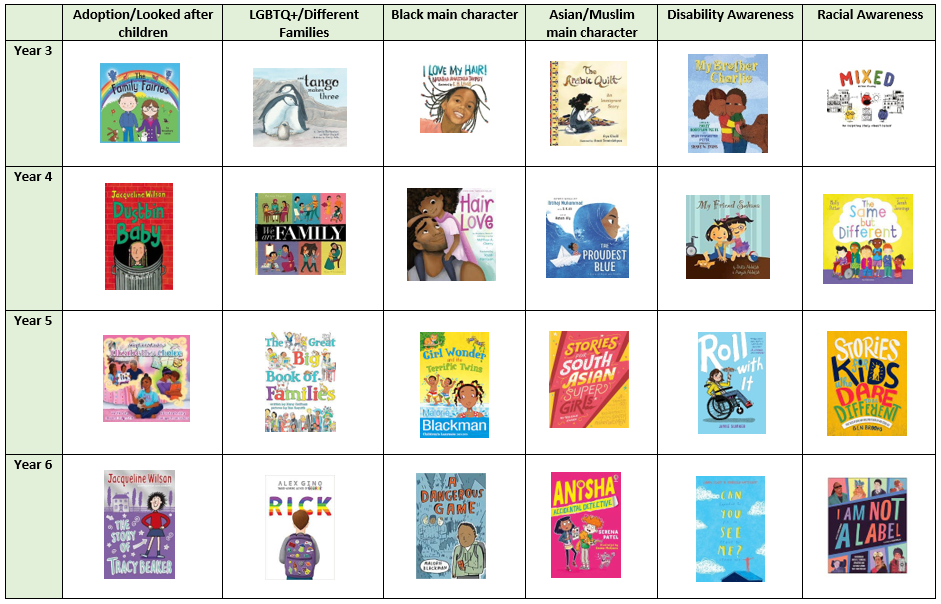
All the books listed below are available for pupils to read in the applicable class. Teachers also use these as the class text at the end of the school day as part of reading for enjoyment.
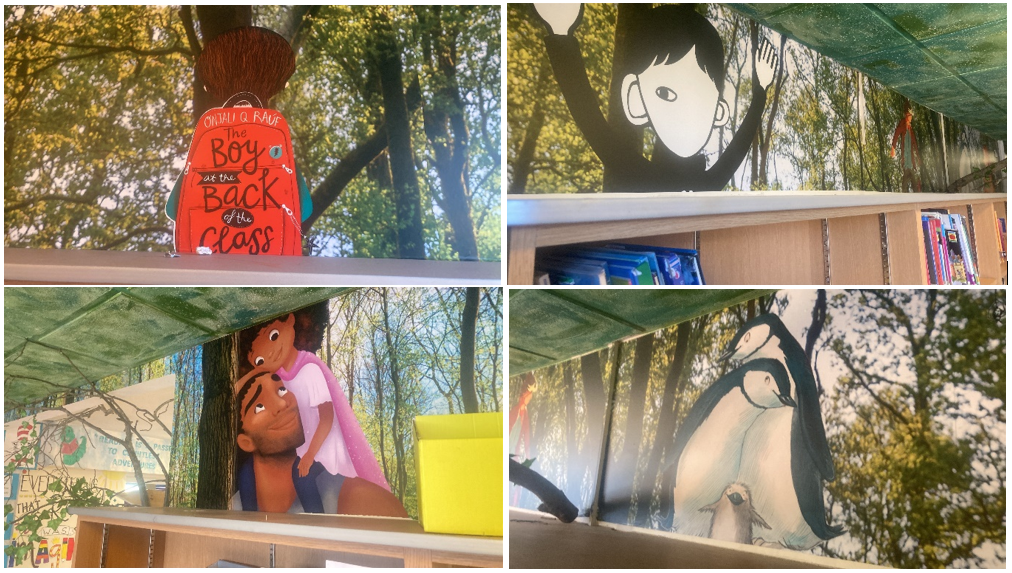
Our school library is also decorated to display and celebrate the diversity of book characters and to further promote pupils to read and enjoy books where the main characters do not reflect their own backgrounds.
As part of our curriculum, texts such as James and the Giant Peach first introduce children to the idea of orphans who do not live with their biological parents. Texts such as 'Journey to Jo'burg' furthers this understanding as the main characters do not live with their mother. This text also ensures we have cultural diversity within our curriculum and ensures our black African children can see themselves reflected within the curriculum.
Older year groups use the text 'Hidden figures' to celebrate the role of black women who helped win the space race. This also enriches our science curriculum. They also explore 'Boy at the back of the classroom' to gain an understanding of life in Syria and the challenges faced by refugees who have been relocated. Pupils also produce leaflets based on Colombia, linked to our chosen charity. Our oldest pupils study 'When the mountains roared' to develop their understanding of children living in a country different to that of their birth and to ensure our Indian children see themselves reflected within the curriculum. Black authors are also studied, including Benjamin Zephaniah. promoting such careers to our male and/or black African pupils whilst ensuring all pupils can enjoy poetry from a range of backgrounds. The London Eye mystery includes a child with Autistic Spectrum Disorder as the main protagonist, furthering pupils' understanding.
.JPG)