
Our curriculum map links and home learning ideas:
ENglish
Please select a year group
Please click here for Year group spelling lists
Year Three
|
Key Vocabulary for year 3 English |
|
|
Vocabulary ongoing throughout the year |
Nouns, adjectives, adverbs, verbs, noun phrase, prefixes, suffixes consonant, vowel, word family, prepositions, paragraphs, sub-headings, clause, subordinating clause, conjunction direct speech, inverted commas (“”) apostrophe (‘), comma (,), question mark (?) exclamation mark (!) |
|
Autumn One – Marcy and the Riddle of the Sphinx |
|
|
Overview |
In this unit, the children will explore the text ‘Marcy and the Riddle of the Sphinx’ focussing on expanded noun phrases, pronouns, prepositions, speech, past tense and adverbs. They will use these features to describe a setting, describe a character, write a conversation between characters as well as planning, writing and editing their own adventure story. |
|
Career/Mantle and Spirituality |
Children explore the role of adventurers, explorers and Egyptologists. Marcy and The Riddle of the Sphinx offers rich opportunities to explore themes of courage, integrity, and resilience. It conveys how Marcy's journey is not just about external adventure but also about internal growth—learning to trust oneself, make ethical decisions, and face fears. |
|
Pupils will be assessed through: |
At the end of the unit, children will independently write their own adventure story based on events from the book Marcy and the Riddle of the Sphinx. |
|
Previous skills and knowledge to be revisited |
Children will revisit a range of skills previously taught in Key Stage 1 including: noun phrases, past tense, conjunctions and capital letter. Children will build upon their narrative writing using character and setting description. |
|
Optional home learning |
English: English skills with story or challenge game modes can be found here: KS2 English free game - Grammar, spelling and punctuation for primary school pupils - Crystal Explorers - BBC Bitesize Please also ensure that your child is reading for at least 10 minutes each day and talk to them about their book. |
|
Autumn Two – Around the World in 80 Days |
|
|
Overview |
In this unit, children will explore the text ‘Around the World in 80 Days’. Whilst reading this abridged version children will explore formal and informal language, conjunctions to develop sentences and past tense verbs. They will use these features to write a letter and postcard from the perspective of the book’s two main characters. |
|
Career/Mantle and Spirituality |
Children explore the role of travel writers. Phileas Fogg's journey is essentially an act of faith. He wagers everything on the belief that he can circumnavigate the globe in 80 days. His calm, unshakable demeanour reflects spiritual confidence—he trusts in order, timing, and his purpose, much like a spiritual seeker trusts a higher path. |
|
Pupils will be assessed through: |
At the end of this unit, children will independently write their own informal letter and postcard from the perspective of the main characters. |
|
Previous skills and knowledge to be revisited |
Children will build upon their understanding of past tense and subordinating clauses and conjunctions. They will also develop their writing skills from the 1st person perspective. |
|
Optional home learning |
English skills with story or challenge game modes can be found here: KS2 English free game - Grammar, spelling and punctuation for primary school pupils - Crystal Explorers - BBC BitesizeThis website will help your children learn spelling rules and patterns for their year group: Look, Cover, Write, Check- mobile friendly (ictgames.com) Please also ensure that your child is reading for at least 10 minutes each day and talk to them about their book. |
|
Spring One – Wild Cities |
|
|
Overview |
In this unit, children will explore the text ‘Wild Cities’. They will learn about the different types of nouns, technical vocabulary, descriptive language and the features of diary entries. Children will then plan, write and edit diary entries, articles or blogs about the wild animals living in the cities they see within the book. |
|
Career/Mantle and Spirituality |
Children explore the role of nature writers. The Wild Cities book reveals the natural world thriving in unexpected urban places. Children are encouraged to stop, notice and appreciate beauty in ordinary places. It also demonstrates how animals and humans share living spaces, allowing children to reflect on the responsibility we have towards animals, habitats, and our environment. |
|
Pupils will be assessed through: |
At the end of this unit, children will independently write their own diary entry based on Paris, referring to information provided in the book Wild Cities. |
|
Previous skills and knowledge to be revisited |
Children will continue to build on past tense when writing their diary entries. They will revisit grouping ideas into paragraphs as well as using adjectives for description and emotion. |
|
Optional home learning |
English skills with story or challenge game modes can be found here: KS2 English free game - Grammar, spelling and punctuation for primary school pupils - Crystal Explorers - BBC BitesizeThis website will help your children learn spelling rules and patterns for their year group: Look, Cover, Write, Check- mobile friendly (ictgames.com) Please also ensure that your child is reading for at least 10 minutes each day and talk to them about their book. |
|
Spring Two – Here Comes Hercules |
|
|
Overview |
In this unit, the children will explore the text ‘Here Comes Hercules’ focussing on expanded noun phrases, similes and metaphors, apostrophes and time conjunctions. They will use these features to describe a setting, describe a character, plan and describe their own Greek God/hero, write a recount and write their own story in the style of the text. |
|
Career/Mantle and Spirituality |
Children become animation character designers during this unit of work. The story involves ancient myths and historical figures, like finding clues about Hercules and the gods. This book allows children to think about inner strength. The main character, Hercules, is known for his physical strength. This opens discussion about inner strength—kindness, persistence, courage. |
|
Pupils will be assessed through: |
At the end of this unit, children will independently write a recount based on the events from chapter 7. |
|
Previous skills and knowledge to be revisited |
Children will revisit expanded noun phrases to describe characters and settings. They will use bullet points and short notes to plan their ideas. |
|
Optional home learning |
English skills with story or challenge game modes can be found here: KS2 English free game - Grammar, spelling and punctuation for primary school pupils - Crystal Explorers - BBC BitesizeThis website will help your children learn spelling rules and patterns for their year group: Look, Cover, Write, Check- mobile friendly (ictgames.com) Please also ensure that your child is reading for at least 10 minutes each day and talk to them about their book. |
|
Summer One – The Wild Robot |
|
|
Overview |
In this unit, children will explore the book ‘The Wild Robot’. |
|
Career/Mantle and Spirituality |
Children explore the role of conservationists. They look to protect a newly discovered island where an unfamiliar character lives. The Wild Robot book provides many spiritual traditions and emphasises a deep connection with nature, forming bonds with the natural world and everything that is in it. This is reflected in the Bible verse: “The heavens declare the glory of God; the skies proclaim the work of his hands. Day after day they pour forth speech; night after night they reveal knowledge.” Psalm 19:1–2 suggesting that nature itself speaks of God’s presence, power, and wisdom. |
|
Pupils will be assessed through: |
Throughout this unit, children will independently complete character and setting descriptions of the main character and the island. |
|
Previous skills and knowledge to be revisited |
Children will revisit adjectives looking at comparatives and superlatives. They will also explore descriptive language again, this time focusing on a different setting from previous work. |
|
Optional home learning |
English skills with story or challenge game modes can be found here: KS2 English free game - Grammar, spelling and punctuation for primary school pupils - Crystal Explorers - BBC Bitesize Please also ensure that your child is reading for at least 10 minutes each day and talk to them about their book. |
|
Summer Two – The Boy Who Grew Dragons |
|
|
Overview |
In this unit, children will explore the text ‘The Boy who Grew Dragons’. Focussing on: inverted comas, subordinating conjunctions, imperative verbs, adverbs of manner and present tense. They will use these features to describe a current and new setting, write a persuasive argument, follow and write instructions, create their own dragon and write an explanation text about how to look after a dragon. |
|
Career/Mantle and Spirituality |
Children explore the role of gardeners, they understand how the main character, Tomas, helps grow plants and finds the dragon fruit tree in the garden. Many spiritual beliefs involve faith in things we cannot immediately see or explain. The story encourages readers to believe that there is more to the world than what appears on the surface, which is a key spiritual idea. This is reflected in the Bible verse: Hebrews 11:1, “faith is confidence in what we hope for and assurance about what we do not see.” This connects to The Boy Who Grew Dragons because Tomas discovers dragons growing from a tree, showing that not everything amazing can be explained at first sight. Questions to consider:
|
|
Pupils will be assessed through: |
At the end of this unit, children will independently create an explanation text on how to look after a dragon. |
|
Previous skills and knowledge to be revisited |
Children will revisit direct speech and the use of inverted commas. As well as this they will look at conjunctions, adverbs and the use of paragraphs to group information. |
|
Optional home learning |
English skills with story or challenge game modes can be found here: KS2 English free game - Grammar, spelling and punctuation for primary school pupils - Crystal Explorers - BBC Bitesize Please also ensure that your child is reading for at least 10 minutes each day and talk to them about their book. |
Year Four
|
Key Vocabulary for year 4 English |
|
|
Vocabulary ongoing throughout the year
|
Standard English, verb forms (was/were), Expanded noun phrases, determiner Fronted adverbials, Commas (,) after fronted adverbials Paragraphs, Pronoun, Cohesion across paragraphs, Apostrophes for plural possession (‘) Key vocabulary from year 3 will also be revisit throughout the year. |
|
Autumn One – Nell and the Cave Bear |
|
|
Overview |
In this unit, the children will explore the text 'Nell and the Cave Bear’. They will focus on fronted adverbials, verb forms, conjunctions, expanded noun phrases and inverted commas. They will use these features to describe settings, write and present their opinions through the form of debate, write about the key events in a descriptive way as well as plan, write and edit their own version of the text. |
|
Career/Mantle and Spirituality |
Children explore the role of explorers / survival experts. They will travel back in time to the Stone Age to see how Nell (a young girl) manages when looking after a cave bear as they embark on an adventure away from the tribe. Nell and the Cave Bear intertwines themes of friendship, loyalty and the bond between humans and animals. The bond between Nell and Cave Bear provides a gentle reminder of the importance of connection, respect and the shared journey toward understanding and belonging. This is reflected in the Bible verse: "The wolf will live with the lamb, the leopard will lie down with the goat, the calf and the lion and the yearling together; and a little child will lead them." Isaiah 11:6 – demonstrating a vision of peace and harmony between animals and humans in God's future kingdom. Questions to consider:
|
|
Pupils will be assessed through: |
At the end of this unit, children will independently write their own adventure story in the style of Nell and the Cave Bear. |
|
Previous skills and knowledge to be revisited |
In year 3, children looked at descriptive language for various characters and settings. In this unit, children will revisit the use of description focusing on woodland/forest setting and bravery in characters. |
|
Optional home learning |
English skills with story or challenge game modes can be found here: KS2 English free game - Grammar, spelling and punctuation for primary school pupils - Crystal Explorers - BBC Bitesize Please also ensure that your child is reading for at least 10 minutes each day and talk to them about their book. |
|
Autumn Two – Journey to Jo’Burg |
|
|
Overview |
In this unit, the children will explore the text ‘Journey to Jo'burg’. They will focus on rhyming words, apostrophes for possession, types of speech, direct speech, speech patterns, questioning. They will use these features to write a poem, take on the role of different characters and write diary entries, write letter from characters perspectives and continue the story from what they would do when the characters are reunited with mum. |
|
Career/Mantle and Spirituality |
In this unit, inspired by the book Journey to Jo’Burg, children will explore the role of a human rights activist. The book contains deep emotional and moral themes that can be meaningfully linked to spirituality. In the book, spirituality can be seen as the inner strength, hope, and connection to justice, love, and human dignity that guide the characters through hardship. This is reflected in the Bible verse: "Be joyful because you have hope. Be patient when trouble comes. Pray all the time.” Romans 12:12, which reminds us that hope can give us strength, even when life is hard. Questions to consider: Why do people treat others differently because of how they look or where they’re from? What does family mean to you? Do we all deserve the same rights? |
|
Pupils will be assessed through: |
At the end of this unit, children will plan and draft ideas on what they think should happen when the siblings are reunited with mum. They will independently continue the narrative building on knowledge and skills taught. |
|
Previous skills and knowledge to be revisited |
Children revisit characters feelings and emotions. They will also revisit letter writing, previously learned in year 3. |
|
Optional home learning |
English skills with story or challenge game modes can be found here: KS2 English free game - Grammar, spelling and punctuation for primary school pupils - Crystal Explorers - BBC Bitesize This website will help your children learn spelling rules and patterns for their year group: Look, Cover, Write, Check- mobile friendly (ictgames.com) Please also ensure that your child is reading for at least 10 minutes each day and talk to them about their book. |
|
Spring One – How to Train Your Dragon |
|
|
Overview |
In this unit, children focus on grammar, learning to use nouns, pronouns, and noun phrases effectively, while studying how language and structure shape meaning in instructional texts, particularly through imperative verbs and clear, concise writing. They will develop inference skills by analysing characters’ traits and motivations using evidence from the text. They will explore descriptive language used for settings like cliffs and caves, examining how atmosphere and mood are created, and apply these techniques in their own dragon descriptions. |
|
Career/Mantle and Spirituality |
In this unit, children will explore the role of Dragon trainers, creating a manual for how to capture and train their own dragon. How to Train your Dragon conveys spirituality in several thoughtful ways, especially when considering spiritual growth, identity, and the human connection with nature and the unknown. The Bible verse: “How many are your works, Lord! In wisdom you made them all; the earth is full of your creatures. There is the sea, vast and spacious, teeming with creatures beyond number—living things both large and small.” Psalm 104:24-25 reminds us that God created the vastness of nature with wisdom, and everything has a purpose. Questions to consider: Should we always follow the rules? What makes someone a hero? Do we all have a purpose? |
|
Pupils will be assessed through: |
At the end of this unit, children will create a ‘How to guide’ on training their own dragon they created. |
|
Previous skills and knowledge to be revisited |
Children will revisit the skill of instructional writing previously leant in year 3. They will also revisit character descriptions and actions. |
|
Optional home learning |
English skills with story or challenge game modes can be found here: KS2 English free game - Grammar, spelling and punctuation for primary school pupils - Crystal Explorers - BBC Bitesize Please also ensure that your child is reading for at least 10 minutes each day and talk to them about their book. |
|
Spring Two – The A-Z of Poetry |
|
|
Overview |
In this unit, children will explore a range of poetry forms and their features, including rhyme, similes, metaphors, and alliteration, as well as acrostic, shape, humorous, and rhyming poems. They will also develop their understanding of vocabulary and word choice, analysing how language features influence mood and applying these techniques in their own poetry writing. |
|
Career/Mantle and Spirituality |
In this unit, children explore the role of Author / Poet. In the book, Michael Rosen shows that writing creatively is a career. This unit allows child to explore a range of different poems. Many of which explore nature, seasons, animals and landscapes. Children can notice beauty, feeling wonder, and appreciate the world. This is reflected in the Bible verse: Genesis 1:31 – “God saw all that he had made, and it was very good.” Encouraging children to notice and appreciate the goodness of creation.
|
|
Pupils will be assessed through: |
At the end of this unit, children will independently write their own poem based on an example from the book. |
|
Previous skills and knowledge to be revisited |
Children will revisit rhyme and onomatoepia through poetry, previously learnt in year 3. |
|
Optional home learning |
English skills with story or challenge game modes can be found here: KS2 English free game - Grammar, spelling and punctuation for primary school pupils - Crystal Explorers - BBC Bitesize Please also ensure that your child is reading for at least 10 minutes each day and talk to them about their book. |
|
Summer One – The Explorers |
|
|
Overview |
In this unit, the children will focus on synonyms to build vocabulary, direct speech patterns, apostrophes, fronted adverbials and uses of commas. They will use these features to describe a setting (Amazon Rainforest), construct conversational writing between characters, integrate speech within narratives, build tension in narratives and to plan, write and edit their own story in the style of The Explorer. |
|
Career/Mantle and Spirituality |
Children will become conservations, linking to their work on rainforests in geography. The book provides strongly links to inner growth, hope, and the human connection with nature. Spirituality is seen through the characters’ journey of self-discovery, their deep connection with nature, and the hope and trust that help them survive. |
|
Pupils will be assessed through: |
At the end of the unit, children will independently create a new dramatic opening to the book. |
|
Previous skills and knowledge to be revisited |
Children will revisit setting description and dialogue previously learnt in the autumn term. They will revisit expanded noun phrases looking to modify them with adjectives. |
|
Optional home learning |
English skills with story or challenge game modes can be found here: KS2 English free game - Grammar, spelling and punctuation for primary school pupils - Crystal Explorers - BBC Bitesize Please also ensure that your child is reading for at least 10 minutes each day and talk to them about their book. |
|
Summer Two – Revolt Against the Romans |
|
|
Overview |
In this unit, the children will explore the text ‘Revolt Against the Romans’. They will focus on synonyms, standard English, adverbs with noun phrases, prepositional phrases and apostrophes for possession. They will use these features to identify and describe character traits, write and present an argument, research Roman Britain, write and edit an information page and explore and write a persuasive brochure for Colchester Castle. |
|
Career/Mantle and Spirituality |
Children will become advertisers for Colchester Castle. In Revolt Against the Romans, the spiritual theme is shown through Marcus’s journey of self-discovery, as he questions his beliefs and learns where his true loyalty and sense of belonging lie. This is reflected in the Bible verse: “Be strong and courageous. Do not be afraid… for the Lord your God goes with you.” Questions to consider:
|
|
Pupils will be assessed through: |
At the end of this unit, children will create their own persuasive leaflet for Colchester Castle. |
|
Previous skills and knowledge to be revisited |
The writing outcomes during this unit of work have not previously been taught. Children will use their knowledge from a trip to Colchester Castle and build this into their writing. |
|
Optional home learning |
English skills with story or challenge game modes can be found here: KS2 English free game - Grammar, spelling and punctuation for primary school pupils - Crystal Explorers - BBC Bitesize Please also ensure that your child is reading for at least 10 minutes each day and talk to them about their book. |
Year Five
|
Key Vocabulary for year 5 English |
|
|
Vocabulary ongoing throughout the year
|
Modal verb, relative clause, relative pronoun Parenthesis (including brackets () and dashes -) Cohesion within paragraphs Adverbials (time, place and number) Verb prefixes (dis-, de-, mis-, over-, re-) Suffixes (to convert nouns/adjectives into verbs) Key vocabulary from year 3 and year 4 will also be revisit throughout the year. |
|
Autumn One – Hidden Figures |
|
|
Overview |
In this unit, children will explore the text 'Hidden Figures' focussing on emotive language, modal verbs, formal language, adverbials of time, relative pronouns and clauses and parenthesis. They will use these features to write diary entries from the perspective of key figures, formal letters, and biographies. |
|
Career/Mantle and Spirituality |
Hidden Figures provides children with the insight into careers in Mathematics and Space Technology. Hidden Figures provides a spiritual lens to understand the deeper themes and motivations of the women including hope, moral courage and righteousness. This is reflected in the Bible verse: “Have I not commanded you? Be strong and courageous. Do not be afraid; do not be discouraged, for the Lord your God will be with you wherever you go.” Joshua 1:9, which reminds us how inner strength and courage are used in the face of hardship. Questions to consider: What is fairness? Can knowledge be a kind of power? What gives people strength when things feel unfair? Why is it important to believe in yourself? |
|
Pupils will be assessed through: |
At the end of this unit, children will independently write their own biography based on one of the key women in the text. |
|
Previous skills and knowledge to be revisited |
The writing outcomes during this unit of work have not previously been taught. Children will use their knowledge from the book Hidden Figure, as well as independent research for their writing. |
|
Optional home learning |
English skills with story or challenge game modes can be found here: KS2 English free game - Grammar, spelling and punctuation for primary school pupils - Crystal Explorers - BBC Bitesize Please also ensure that your child is reading for at least 10 minutes each day and talk to them about their book. |
|
Autumn Two – The Boy at the Back of the Class |
|
|
Overview |
In this unit, children will explore the text 'The Boy at the Back of the Class focussing on subordinating conjunctions, dashes, synonyms, adverbs, figurative language, rhetorical questions and informal language. They will use these features to write an information text, write from different character perspectives, recalling key events and editing, explore character emotions, write a 1-sided argument and an informal letter to a relative in the text.
|
|
Career/Mantle and Spirituality |
In this unit, children will explore the role of a Refugee Support Worker. Understanding how their role helps people who have left their home countries because of danger or conflict. In this unit, spirituality is explored in different ways including: kindness and compassion as the narrator and their friends care deeply about Ahmet, even though they don’t know his whole story. They show kindness by helping him feel safe and included. Also, standing up for what’s right as the children don’t just notice something unfair — they do something about it. Spirituality is often about standing up for justice and peace, even when it's hard. This is reflected in the bible verse: "Do not forget to show kindness to strangers. Some people have done this and welcomed angels without knowing it." Hebrews 13:2 This verse reminds us to always be kind to people we don’t know — just like the kids in the story were kind to Ahmet. When we welcome others with love and open hearts, we are doing something very special and important. Questions to consider:
|
|
Pupils will be assessed through: |
During this unit, children will plan, design and create their own leaflet about Syria and how refugees are supported. |
|
Previous skills and knowledge to be revisited |
Children have previously researched and made notes on key topics in both year 3 and 4 and used this to present it under subheadings. |
|
Optional home learning |
English skills with story or challenge game modes can be found here: KS2 English free game - Grammar, spelling and punctuation for primary school pupils - Crystal Explorers - BBC Bitesize This website will help your children learn spelling rules and patterns for their year group: Look, Cover, Write, Check- mobile friendly (ictgames.com) Please also ensure that your child is reading for at least 10 minutes each day and talk to them about their book. |
|
Spring One – Beowulf |
|
|
Overview |
Children explore Beowulf, including its history as a spoken tale, narrative poem, and written story. They will study grammar features such as hyphens for clarity, direct speech, and word meanings, and apply these skills by writing character descriptions and creating, editing, and refining their own version of the Beowulf and Grendel story. |
|
Career/Mantle and Spirituality |
In this unit, children explore the work of Oral Storytellers, linking to their Anglo-Saxon work in history, children create their own version of Beowulf to read aloud to the class. Children are able to explore inner strength and the qualities that help us face difficult challenges. In the book the character Beowulf consistently chooses courage over fear. When Beowulf fights the dragon despite knowing the danger, it raises questions about self-sacrifice and what makes someone a hero. This is reflected in the Bible verse: Psalm 27:1 – “The Lord is my light and my salvation; whom shall I fear?” Reminding us how the Bible encourages trust and bravery in facing fear Questions to consider: What values make someone heroic? |
|
Pupils will be assessed through: |
At the end of this unit, children will plan and write their own adventure story in the style of Beowulf. |
|
Previous skills and knowledge to be revisited |
Dialogue and inverted commas will be revisited during this unit, as well as organising ideas into paragraphs and relative clauses. |
|
Optional home learning |
English skills with story or challenge game modes can be found here: KS2 English free game - Grammar, spelling and punctuation for primary school pupils - Crystal Explorers - BBC Bitesize Please also ensure that your child is reading for at least 10 minutes each day and talk to them about their book. |
|
Spring Two – *Yo* |
|
|
Overview |
In this unit, children will explore poetry through rap, focusing on the work of Christian Foley. They will learn about different rap forms and features such as repetition, similes, and metaphors. Pupils will then develop performance skills by analysing rap structure before planning, drafting, and performing their own raps inspired by his work. |
|
Career/Mantle and Spirituality |
In this unit, children will explore rap and take on the role of rappers and perform their own raps in the style of Christian Foley. Through exploring the work of Christian, children consider wonder in everyday life, undertake self-reflection and connect with their emotions. This is reflected in the Bible verse, “The heavens declare the glory of God; the skies proclaim the work of his hands.” Psalm 19:1 reminding us of wonder and awe and how we see God in everyday creation. Questions to consider: - Where do you notice beauty in the world? - Why do you think nature makes people feel calm? - Do you think nature can teach us something? What? - When have you felt amazed by something simple? |
|
Pupils will be assessed through: |
Throughout this unit of work, children will be regularly assessed through writing and performing a range of poems in the style of the poet Christian Foley. |
|
Previous skills and knowledge to be revisited |
Children have previously explored, rhyme, similes and onomatopoeia in years 3 and 4 during poetry units. Children will use techniques from example poems/raps in their own. |
|
Optional home learning |
English skills with story or challenge game modes can be found here: KS2 English free game - Grammar, spelling and punctuation for primary school pupils - Crystal Explorers - BBC Bitesize Please also ensure that your child is reading for at least 10 minutes each day and talk to them about their book.
|
|
Summer One – The Lion King |
|
|
Overview |
Children explore the use of adjectives and adverbials as well as speech and dialogue. They will use this to explore story structures and create their own sequel to the story. |
|
Career/Mantle and Spirituality |
Children will create a new storyline for a sequel to The Lion King. The story the film teaches that all living things are connected and that life, death, and nature are part of a cycle. This reflects spiritual ideas about respecting life and the world. This is reflected in the Bible verse: God made all living things and saw that it was good. Genisis 1:31, reminding us to respect and care for all creation. Questions to consider:
|
|
Pupils will be assessed through: |
At the end of this unit, children will independently write their own sequel to the book The Lion King. |
|
Previous skills and knowledge to be revisited |
Children will use the knowledge of the story from the west end show. They will explore setting descriptions using expanded noun phrases. |
|
Optional home learning |
English skills with story or challenge game modes can be found here: KS2 English free game - Grammar, spelling and punctuation for primary school pupils - Crystal Explorers - BBC Bitesize Please also ensure that your child is reading for at least 10 minutes each day and talk to them about their book.
|
|
Summer Two – The Nowhere Emporium |
|
|
Overview |
In this unit, the children will focus on vocabulary and language, direct speech (inverted commas and punctuation), clause structures and dialogue to advance the action. They will use these features to use their senses within descriptive writing, explore and create their own imaginary setting, introduce new characters, explore how plots develop and plan, write and edit their own narrative based on their own setting.
|
|
Career/Mantle and Spirituality |
Children will explore the term entrepreneur, creating their own mystical, antique, magical shop to design and describe. |
|
Pupils will be assessed through: |
At the end of this unit, children will write their own narrative description creating their own mystical shop. |
|
Previous skills and knowledge to be revisited |
Children will revisit expanded noun phrases, similes, descriptive language, figurative language. |
|
Optional home learning |
English skills with story or challenge game modes can be found here: KS2 English free game - Grammar, spelling and punctuation for primary school pupils - Crystal Explorers - BBC Bitesize Please also ensure that your child is reading for at least 10 minutes each day and talk to them about their book.
|
Year Six
|
Key Vocabulary for year 6 English |
|
|
Vocabulary ongoing throughout the year
|
Formal and informal speech, Synonyms and antonyms, Active and passive voice, Subject, object, verb Question tags, Subjunctive forms, Ellipsis for cohesion Semi-colon ( ; ) colon ( : ) dash ( - ) (used for boundaries between independent clauses, Hyphens - Key vocabulary from years 3, 4 and 5 will also be revisit throughout the year. |
|
Autumn One – Street Child |
|
|
Overview |
In this unit, Children will explore the text 'Street Child' focusing on synonyms, hyphens, dialogue and appropriate punctuations, relative clauses and adverbials. They will use these features to describe settings within narratives, describe characters, integrate dialogue into narratives a as well as planning, writing and editing their own journey story. As well as this, children will plan and write their own balanced argument on whether the workhouses should or should not have closed. |
|
Career/Mantle and Spirituality |
In this unit inspired by Street Child students will explore the role of Politician. In this role, students will debate whether workhouses should have been closed, considering the historical context of child labour and poverty. In Street Child, Jim's struggles reflect the biblical call to care for the marginalized. Matthew 25:40 – "Truly I tell you, whatever you did for one of the least of these brothers and sisters of mine, you did for me" – reminds us that helping those in need is like helping Jesus Himself. Jim's story highlights how small acts of compassion can bring hope and change, echoing biblical values of love and care for the less fortunate. |
|
Pupils will be assessed through: |
At the end of this unit, children will independently write a balanced argument taking into consideration events from the book Street Child and knowledge learnt in history lessons. |
|
Previous skills and knowledge to be revisited |
Children will use their knowledge from history lesson and apply this to their writing. They will use relative clauses, parenthesis and adverbials. |
|
Optional home learning |
English skills with story or challenge game modes can be found here: KS2 English free game - Grammar, spelling and punctuation for primary school pupils - Crystal Explorers - BBC Bitesize Please also ensure that your child is reading for at least 10 minutes each day and talk to them about their book.
|
|
Autumn Two – The Last Bear |
|
|
Overview |
In this unit, children will learn grammar skills such as using noun phrases and adverbials, alongside identifying features of effective speeches. They will develop reading skills by predicting events and taking notes and learn how to plan and write persuasive speeches .Using The Last Bear, children will create descriptive writing about the Arctic, apply persuasive techniques, and explore themes like climate change, helping to build their grammar, creativity, critical thinking, and communication skills. |
|
Career/Mantle and Spirituality |
In this unit, inspired by The Last Bear, children will explore the career of an animal rights activist, focusing on roles dedicated to protecting animals and their habitats. The Last Bear by Hannah Gold emphasizes the spiritual connection between humans and nature, encouraging respect and care for the Earth. This idea is reflected in the Bible verse, “The earth is the Lord's, and everything in it, the world, and all who live in it.” (Psalm 24:1), which reminds us that the Earth is a gift, and we are called to care for it. |
|
Pupils will be assessed through: |
At the end of this unit, children will plan and write a powerful speech about climate change. |
|
Previous skills and knowledge to be revisited |
Children will use knowledge from the book as well as independent research to provide relevant information. They will use previous note taking skills to bullet point ideas. |
|
Optional home learning |
English skills with story or challenge game modes can be found here: KS2 English free game - Grammar, spelling and punctuation for primary school pupils - Crystal Explorers - BBC Bitesize This website will help your children learn spelling rules and patterns for their year group: Look, Cover, Write, Check- mobile friendly (ictgames.com) Please also ensure that your child is reading for at least 10 minutes each day and talk to them about their book.
|
|
Spring One – When the Mountains Roared |
|
|
Overview |
Children will explore a range of writing genres, including diary entries, descriptive settings, and reviews. They will develop planning and editing skills, use punctuation such as colons and semi-colons, and apply descriptive language to create vivid writing. Children will also learn to recognise modal verbs and analyse language choices, using these skills across narrative, descriptive, and persuasive writing, including crafting a negative hotel review. |
|
Career/Mantle and Spirituality |
In this unit, children will step into the shoes of a hotel reviewer, exploring the essential skills needed to evaluate and critique hospitality experiences. They'll develop an understanding of what makes a hotel exceptional, from service and ambiance to amenities and location. In Where the Mountains Roared, the mountains symbolize spiritual strength and connection, similar to biblical themes where mountains are sacred places of God's presence. This reflects the idea that nature can be a source of guidance and peace. As Psalm 121:1-2 says, "I lift up my eyes to the mountains—where does my help come from? My help comes from the Lord, the Maker of heaven and earth." |
|
Pupils will be assessed through: |
At the end of this unit, children will be assessed by independently planning and writing a hotel review based on the book When the Mountains Roared. |
|
Previous skills and knowledge to be revisited |
Children will revisit and develop their diary entry skills. Using simple past and past progressive tense. They will use emotive language and 1st person pronouns. |
|
Optional home learning |
English skills with story or challenge game modes can be found here: KS2 English free game - Grammar, spelling and punctuation for primary school pupils - Crystal Explorers - BBC Bitesize
|
|
Spring Two – The Highwayman |
|
|
Overview |
Children will learn key grammar skills, including using adverbs and adverbials to modify verbs and revising relative clauses. They will develop reading skills by summarising across paragraphs and analysing vocabulary, figurative language, and poetic devices. They will apply these skills through writing, including recounts and formal letters, focusing on structure, tone, and clarity. Activities such as hot seating will help deepen understanding of characters’ perspectives, motivations, and emotions, supporting both narrative and formal writing development. |
|
Career/Mantle and Spirituality |
In this unit, inspired by The Highwayman poem, children will take on the role of a civil rights advocate, similar to how individuals today fight for justice and fairness. Ephesians 4:32 – "Be kind and compassionate to one another, forgiving each other, just as in Christ God forgave you" – relates to The Highwayman through Bess's kindness and loyalty. Despite the danger, she helps the Highwayman out of love, showing compassion and selflessness, much like the Bible verse encourages us to treat others with kindness and forgiveness. |
|
Pupils will be assessed through: |
At the end of this unit, children will independently write a recount of The Highwayman poem in the form of a narrative. |
|
Previous skills and knowledge to be revisited |
Children will revisit onomatopoeia, repetition, similes, personification. As well as this, children will revisit narrative writing using figurative language. |
|
Optional home learning |
English skills with story or challenge game modes can be found here: KS2 English free game - Grammar, spelling and punctuation for primary school pupils - Crystal Explorers - BBC Bitesize |
|
Summer One – Editing and Publishing |
|
|
Overview |
During English lessons in the Summer Term, children will focus on editing and publishing pieces of their own work, as well as creating their own short stories. Children will revise grammar and punctuation which can be used within their writing.
|
|
Career/Mantle and Spirituality |
In the editing unit, Proverbs 12:1 – "Whoever loves discipline loves knowledge, but whoever hates correction is stupid" – highlights the importance of embracing correction in the writing process. Just as the verse emphasises the value of discipline and learning through correction, students will learn to value editing as a way to improve their writing. Editing allows them to refine their short stories, correcting mistakes and enhancing clarity, ultimately helping them grow as writers
|
|
Pupils will be assessed through: |
During this unit of work, children will work on previously written pieces of work. Proof-reading, editing and redrafting them. |
|
Previous skills and knowledge to be revisited |
Children will revisit a range of grammatical skills taught over key stage 2 when proof-reading, editing and redrafting their writing. |
|
Optional home learning |
English skills with story or challenge game modes can be found here: KS2 English free game - Grammar, spelling and punctuation for primary school pupils - Crystal Explorers - BBC Bitesize
|
|
Summer Two – Short Stories |
|
|
Overview |
In this unit, the children will explore character feelings in a short story, explore descriptive phrases, write a brief description of a setting, explore senses to build up fear and plan, write and edit their own short story in the style of similar stories. They will also explore a playscript as part of their end of year performance focusing on stage direction, narration, acting and performance.
|
|
Career/Mantle and Spirituality |
This unit enables children to explore values and morals. Characters face choices (good vs evil, bravery vs fear). Children reflect on, what they would do and what is “right”. This builds moral and spiritual awareness. This is reflected in the Bible verse: Psalm 119:105“Your word is a lamp to my feet and a light to my path.” Questions to consider:
|
|
Pupils will be assessed through: |
At the end of this unit, children will plan, draft and edit their own short warning story. |
|
Previous skills and knowledge to be revisited |
Children will revisit planning and drafting narrative writing. They will revisit dialogue and cohesion within and across paragraphs. |
|
Optional home learning |
English skills with story or challenge game modes can be found here: KS2 English free game - Grammar, spelling and punctuation for primary school pupils - Crystal Explorers - BBC Bitesize Please also ensure that your child is reading for at least 10 minutes each day and talk to them about their book.
|
French
Please select a year group
Year Three
|
Autumn – French Greetings |
|
|
Overview |
In this unit, children will use puppets to practise a variety of French greetings and learn how to introduce themselves. They will also understand how to choose the correct greeting based on the time of day and ask someone how they are. |
|
Career/Mantle and Spirituality |
Children explore the role of a puppeteer during this unit of work. They design and create a finger puppet (paper, card) and use this to perform using the different greetings they have learnt. Children are reminded that greetings are more than just polite words—they’re a form of connection, respect, and recognition of others' presence, which resonates with many spiritual traditions. This is reflected in the Bible verse: 3 John 1:14 "...Peace to you. The friends here send their greetings. Greet the friends there by name." Questions to consider: • How can we get to know God? • Do you think greetings can change someone's day? Why? • What does it mean to greet someone “from the heart”? |
|
Key vocabulary |
Bonjour, salut, au revoir, bonsoir, bonne nuit, ça va bien, ça va mal, c’est..., comment tu t’appelles ?, je m'appelle..., non, oui |
|
Pupils will be assessed through: |
At the end of this unit, children will participate in a puppet show performing a rhyme in French, consolidating the greetings learnt over the unit. |
|
Previous skills and knowledge to be revisited |
In Key Stage 1, there is no programme of study for French. This unit, French Greeting, introduces children to French.
|
|
Optional home learning |
This website will help children to consolidate their understanding of different greetings in French French Greetings - Match up (wordwall.net) |
|
Spring – Adjectives of colour, shape and space |
|
|
Overview |
In this unit, children will describe shapes using adjectives of colour and size. They will learn the position of adjectives relative to the noun; identify cognates, practise language skills and develop confidence through games and creating animal artworks. |
|
Career/Mantle and Spirituality |
Children explore the work of artists, to create their own piece of art in the style of Matisse labelling it in French. This unit allows children to consider values like awe, creativity, identity, and appreciation of difference. Exploring how objects are describes provides children with the opportunity to reflect on how everyone is uniquely and beautifully made. This links to the Bible verse: “Yet you, Lord, are our Father. We are the clay, you are the potter; we are all the work of your hand.” Isaiah 64:8 reminding us symbolically about form and shape, showing how God shapes our lives like a potter forms clay. Questions to consider: • What do you think a colour might feel like? Is blue always sad or can it be peaceful too? • Do our favourite colours say something about who we are? • Do things change colour, shape, or size when we look at them with love? • Do some shapes feel soft and friendly, while others feel sharp or scary? |
|
Key vocabulary |
Rouge, bleu, jaune, vert, orange un cercle, un triangle, un carré, un rectangle, grand, petit, c'est |
|
Pupils will be assessed through: |
At the end of this unit, children will create their own picture in the style of Matisse. Using animals as the focus for the pictures, children will use shapes of varying sizes and colours to represent the animals. |
|
Previous skills and knowledge to be revisited |
Children will build on listening and responding to single words and short phrases and practising speaking with a partner. They will also know that consonants at the end of words in French are not usually pronounced: the ‘t‘ is silent in salut, comment, petit and vert. |
|
Optional home learning |
This website will help children to consolidate their understanding of colours in French French- Colours - Labelled diagram (wordwall.net) |
|
Summer – Playground games and classroom |
|
|
Overview |
In this unit, children learn to count in French from one to twelve including recognising the written number. They ask how old someone is and answer the same question, comparing sentence structures in French and English. They also learn the vocabulary for classroom items and begin to understand that every French noun is either ‘masculine’ or ‘feminine.’ |
|
Career/Mantle and Spirituality |
Children become children’s birthday card designers. Focusing on 1 to 12-year-olds, children use their knowledge learnt in the unit for numbers in French to design birthday cards. As well as this, children become visual merchandisers (shop window designers) they will design a new shop window display for ‘Back to School’ equipment at a local shop. Children are reminded of the idea of gratitude — being thankful for the tools that help us learn. This is reflected in the Bible verse: Psalm 90:12 – “Teach us to number our days, so we can grow wise.” Which reminds us that every day is a gift from God and when we learn to count and talk about our age, we can think about how we’re growing in kindness, learning, and love. Questions to consider: • What makes a good leader in a game? • Why do we have rules in school?
|
|
Key vocabulary |
Un, deux, trois, quatre, cinq, six, sept, huit, neuf, dix, onze, douze un crayon, un taille-crayon, un stylo, un cahier, un sac, une règle, une gomme, une trousse, des ciseaux, j’ai, je n’ai pas, tu as…? |
|
Pupils will be assessed through: |
At the end of this unit, children will be assessed by creating a birthday card. They will present their card to the class stating the age and colours used, reinforcing the vocabulary learned. Children will also design a shop window display stating the school equipment learned throughout the unit of work. |
|
Previous skills and knowledge to be revisited |
Children will understand and notice cognates and near cognates. They will use visual clues to make predictions about the meaning of unfamiliar vocabulary. This unit will enable them to build confidence by repeating short phrases with increasing accuracy and recognise that sounds and spelling patterns can be different from English. Children will understand that every French noun is either masculine or feminine and that most adjectives are placed after the noun in French.
|
|
Optional home learning |
This website will help to consolidate your child’s understanding of classroom equipment in French French classroom objects - Teaching resources |
Year Four
|
Autumn – Portraits |
|
|
Overview |
In this unit, children learn adjectives for describing people’s physical appearance and their personality. They create simple sentences ensuring that the adjectives agree with the gender of the noun. |
|
Career/Mantle and Spirituality |
Children explore the role of cartoonists during this unit of work. They create their own cartoon character based of their own appearance and use adjectives for description of appearance and personality. Children are encouraged to spiritually think about appearance, reflecting deeply on how they see themselves and others—not just physically, but through the lens of inner worth, purpose, and sacred identity. This is reflected in the Bible verse: “So God created man in his own image...” (Genesis 1:27) Questions to consider:
|
|
Key vocabulary |
il a/elle a, il est/elle est, heureux/heureuse, sérieux/sérieuse, les cheveux, les yeux, petit/petite, grand/grande, il s'appelle..., elle s'appelle..., blond(e)(s), noir(e)(s) |
|
Pupils will be assessed through: |
At the end of this unit, children will be assessed by creating a portrait of a character, children will label the features of the character using the vocabulary learned throughout the unit. |
|
Previous skills and knowledge to be revisited |
Children will continue to build confidence from year 3 by repeating short phrases with increasing accuracy. They will select and write short words and phrases and Identify and discuss cognates and begin to explore various language detective strategies.
|
|
Optional home learning |
This website will help children to consolidate their understanding of describing faces in French Learn Describe faces in French for primary with Mix and match game (french-games.net)
|
|
Spring – Number, calendars and birthdays |
|
|
Overview |
In this unit, children learn French numbers 1-31, the days of the week, months of the year, dates and seasons through maths and songs. |
|
Career/Mantle and Spirituality |
Children take on the role of event organisers. In this role they will, create an invitation (poster) advertising the school Spring Easter celebration stating: day, date, month, year and season. This unit encourages children to consider each day as a fresh beginning and an opportunity to live with intention, mindfulness, or in alignment with divine purpose. This is reflected in the Bible verse: “This is the day the Lord has made; let us rejoice and be glad in it.” – Psalm 118:24 which reminds us of being present in the now. Questions to consider:
|
|
Key vocabulary |
Onze, douze, treize, quatorze, quinze, seize, dix-sept, dix-huit, dix-neuf, vingt, vingt-et-un, trente, un anniversaire |
|
Pupils will be assessed through: |
At the end of the unit, children will be assessed by choosing appropriate vocabulary to explain how old they are, when their birthday is and the season it falls in. |
|
Previous skills and knowledge to be revisited |
Children will begin to notice common spelling patterns and recognise that sounds and spelling patterns can be different from English. Children will recall that ‘h’ at the start of a word in French is not pronounced.
|
|
Optional home learning |
This website will help your child to consolidate their understanding of numbers in FrenchFrench Numbers - Teaching resources |
|
Summer – Weather and the water cycle |
|
|
Overview |
In this unit, children learn phrases to describe the weather and vocabulary for the compass points. They count from 1-100 in multiples of ten and combine this knowledge to make statements about what the temperature is in different parts of France and to deliver a weather forecast. |
|
Career/Mantle and Spirituality |
Children explore the role of meteorologist. They role play in French reporting on the weather before updating the school community via William Ford Radio. In this unit, children can see weather as awe and wonder of nature. It allows children to reflect on the power and beauty of weather in the world. Children can explore how rain nurtures life, how storms demonstrate nature’s force, and how sunshine lifts moods. This is reflected in the Bible verse: Acts 14:17 "But he has given proof of what he is like. He has shown kindness by giving you rain from heaven. He gives you crops in their seasons. He provides you with plenty of food. He fills your hearts with joy." This reminds us that rain is a gift from God to help things grow and give us food. Questions to consider:
|
|
Key vocabulary |
il fait beau, il fait mauvais, il fait chaud, il fait froid, il pleut, il neige, il y a du soleil, il y a du vent, le nord, le sud, l'est, l'ouest |
|
Pupils will be assessed through: |
At the end of the unit, children will create a brief weather report stating the recent weather and temperature in the local area. |
|
Previous skills and knowledge to be revisited |
Children will recognise some familiar French words when written in a short phrase and how intonation and gesture are used to differentiate between statements and questions. They will also and begin to predict key word patterns and spellings.
|
|
Optional home learning |
This website will help your child to consolidate their understanding of weather in French French Weather - Teaching resources |
Year Five
|
Autumn – Space Exploration |
|
|
Overview |
In this unit, children develop listening and language detective skills through a space theme. They use figurative language and develop sentence structure by adding adjectives and prepositions; they also make simple adjectival comparisons. |
|
Career/Mantle and Spirituality |
Inspired by the global effort of space exploration and French being one of the official languages of the European Space Agency (ESA), children will learn space vocabulary to simulate being part of an international space mission team. Children will record a verbal message describing the planets seen from space on a recent mission. They unit of work, enables children to reflect on life’s big questions, awe and wonder, and our place in the universe. It allows children to consider the concept of infinity and discuss how space has no end, and how that idea can relate to spiritual ideas of the infinite or eternal. This is reflected in the Bible verse: The God said, “Let there be lights in the expanse of the heavens to separate the day from the night, and let them be for signs and for seasons and for days and years.” Genesis 1:14 Questions to consider:
|
|
Key vocabulary |
le Système solaire, le Soleil, la Lune, la Terre, une planète, l’espace, plus ... que, moins ... que, grand, petit, chaud, froid |
|
Pupils will be assessed through: |
At the end of the unit, children will be assessed on describing a planet using the correct noun/adjective agreement. |
|
Previous skills and knowledge to be revisited |
Children will recap identifying key information in simple writing and use a range of language detective strategies to decode new vocabulary. They will speak and read aloud with increasing confidence and fluency and know that a change in voice intonation can indicate when a question is being asked.
|
|
Optional home learning |
This website will help children to consolidate their understanding of using adjectives in French French lessons to learn primary Grammar - adjectives 1 free (french-games.net) |
|
Spring – My family |
|
|
Overview |
In this unit, children are introduced to family and relations vocabulary. They also learn the possessive adjective- my, and how to express likes and dislikes. Work builds on from previous units as children describe members of a family including: their looks, their ages, their birthdays and their likes and dislikes. |
|
Career/Mantle and Spirituality |
Children take on the role of a genealogist, exploring family trees and naming family members. This unit enables children to develop a better understanding of themselves by reflecting on their own family and who is important to them. They learn to appreciate and respect different cultures by exploring similarities and differences in families. This is reflected in the Bible verse: Ephesians 4:32 Questions to consider:
|
|
Key vocabulary |
mon frère, ma sœur, fils/fille unique, mon père, ma mère, mes parents, mon grand-père, ma grand-mère, mon oncle, ma tante, mon cousin, ma cousine |
|
Pupils will be assessed through: |
At the end of this unit, children will plan, prepare and present a brief presentation describing their family. |
|
Previous skills and knowledge to be revisited |
Children will recap identifying key information in simple writing and speak in full sentences using known vocabulary. They will also understand that words in French and English will not always have a direct equivalent in the other language.
|
|
Optional home learning |
Encourage your child to share the new vocabulary learnt in French naming family members in French. The following website contains activities and videos linked family: KS2 French - BBC Bitesize |
|
Summer – Shopping |
|
|
Overview |
In this unit, children learn to construct high numbers in French. They develop food-related vocabulary through games, stories and role-play and build on their understanding of sentence structures, questions and phrases, equipping themselves with language they could use when shopping in France. |
|
Career/Mantle and Spirituality |
Children take on the role of shop owners/assistants. In this role they will, price items for a shop and use Euros to make purchases. They will build on French greetings to interact with customers and exchange money. This unit allows children to consider different values including: gratitude (for what we eat), mindfulness (in eating and choosing food), generosity and sharing meals, respect (for our bodies, others and the planet) and cultural appreciation (how food connects communities). This is reflected in the Bible verse: Matthew 6:11 – "Give us this day our daily bread." Which reminds us to be thankful for the food we have each day — a powerful reflection when learning about buying and preparing food. Questions to consider:
|
|
Key vocabulary |
Trente, quarante, cinquante, soixante, soixante-dix, quatre-vingts, quatre-vingt-dix, cent, ça fait ..., c’est combien ? |
|
Pupils will be assessed through: |
At the end of the unit, children will create their own brief story in the style of M.Mangetout (lesson 3) building on the vocabulary learned throughout the unit. |
|
Previous skills and knowledge to be revisited |
Children will use a range of language detective strategies to decode new vocabulary including context and text type and use intonation and gesture to differentiate between statements and questions. |
|
Optional home learning |
This website will help children to consolidate their understanding of using food and shopping in French French lessons to learn Groceries for primary learners |
Year Six
|
Autumn – French Sport and the Olympics |
|
|
Overview |
In this unit, children learn that conjugating the verb aller – to go means recognising it in different forms. They identify correct prepositions as well as learn sports vocabulary. |
|
Career/Mantle and Spirituality |
Inspired by a range of Olympic sports, children will explore Olympic and International Sports Careers. They will focus on roles involved in competing as an athlete, supporting as a coach and sports officials and referees. They will learn about international events where French is an official language and how multilingual communication is useful. This unit enables children to recognise the values of spiritual development The Olympic Games promote, such as: respect (for others, different cultures, and rules); excellence (striving to be your best, which can be linked to personal growth and self-discipline) and friendship: unity among nations, showing empathy and understanding across cultures. This links to the Bible verse, 2 Timothy 2:5 “An athlete is not crowned unless he competes according to the rules.” Questions to consider:
|
|
Key vocabulary |
le sport, je joue, je fais, le football, le basketball, le tennis, le rugby, le ski, la boxe, le gymnastique, la natation, le tir à l'arc, le skate, j'aime, j'adore, je déteste |
|
Pupils will be assessed through: |
At the end of this unit, children will be assessed by writing a brief paragraph about the Olympic Games stating: duration of the games; start and end date; sports competed in and countries which participate. |
|
Previous skills and knowledge to be revisited |
Children will read and use language detective skills to assess meaning including context, text type and sentence structure. They will use a bilingual dictionary to select alternative vocabulary for independent sentence building and speak in full sentences using known vocabulary.
|
|
Optional home learning |
This website will help children to consolidate their understanding of different sports in French SP French sports - Find the match (wordwall.net) |
|
Spring – French Football Champions |
|
|
Overview |
In this unit, children practise language-learning strategies and develop reading, speaking and listening skills through a football-related theme. They learn how to respond to questions about football players and write football player profiles in French. |
|
Career/Mantle and Spirituality |
Children explore the role of a sports commentator/ journalist. They will understand how the roles: report on football matches in French-speaking countries and interview players, write match reports, or appear on TV. This unit allows children to understand how sport connects with personal values, community, identity, and deeper meaning beyond physical activity. Children can explore belonging and identity as football brings people together across cultures and languages. This is reflected in the Bible verse: Two are better than one because they have a good return for their labour. For if either of them falls, the one will lift up his companion. But woe to the one who falls when there is not another to lift him up. Ecclesiastes 4:9-10 which reminds children on how being part of a team or supporting a team can create a sense of identity and belonging. Questions to consider:
|
|
Key vocabulary |
le ballon, le but, le sifflet, le terrain, marquer un but, mi-temps, sauver un but, un carton jaune, un carton rouge, une équipe, un match de foot, un footballeur/footballeuse |
|
Pupils will be assessed through: |
At the end of this unit, children will create a footballer player profile in French. This will include: name, age, nationality, team name and position played. |
|
Previous skills and knowledge to be revisited |
Children will use further contextual clues and cues, such as awareness of grammatical structures to deduce unknown vocabulary. They will speak and read aloud with increasing confidence and fluency and use intonation and gesture to differentiate between statements and questions. Childre will also know whether to use the pronouns il ‘he’ or elle ‘she’ when describing someone.
|
|
Optional home learning |
This website will help children to consolidate their understanding of sport and countries in FrenchFrench lessons to learn Sports for primary pupils free (french-games.net)
|
|
Summer – Visiting a French Town |
|
|
Overview |
In this unit, children learn directional, transport and town vocabulary together with prepositional phrases. They describe their journey to school, plan a trip to France and become tourist guides, giving reasoned opinions on which places in town to visit. |
|
Career/Mantle and Spirituality |
Children explore the role of a tour leader. They will understand how this role shows/guides people around cities and use French to talk to local businesses, hotels, and visitors. Exploring new places helps us grow in understanding, wonder, and connection with others. In this unit, children can gain a sense of wonder and curiosity. Spirituality grows when we are amazed by how different and beautiful the world can be. The Bible verse: “Love your neighbour as yourself.”— Mark 12:31 encourages kindness, respect and care when learning about different people and places. It reminds us how we show hospitality, friendship, and interest in others. Questions to consider:
|
|
Key vocabulary |
en voiture, en bus, en train, en avion, à vélo, à pied entre, autour de, au bord de, loin de, la droite, la gauche |
|
Pupils will be assessed through: |
At the end of this unit, children will create a tourist leaflet, in French, for their own local area. |
|
Previous skills and knowledge to be revisited |
Children will recap listening and understanding information from an extended audio passage using language detective skills. Developing extended sentences to justify a fact or opinion. To know that parce que (because) can be used to extend a sentence and give a justification.
|
|
Optional home learning |
This website will help children to consolidate their understanding of French Towns in French French Places in town - Teaching resources |
Other curriculum information
Our curriculum intent applied to language and literacy
|
Our school intent |
How we apply this in Language and Literacy |
|
To be successful:
|
The English curriculum enables children with the opportunity to read and look in depth at a wide range of genre books linking to the foundation curriculum. For example: Revolt against the Romans linking to the Year 4 History Romans unit; Hidden Figures linking to the Year 5 space unit in science and Street Child in Year 6 supporting their history unit on The Victorians. English lessons provide children with opportunities for written and spoken outcomes of lessons. Across units of work, there is coverage of drama, role play debates across the curriculum. Each unit of work builds towards the children creating an end piece of writing for a range of different purposes and genres. Lessons are recorded in a variety of ways, having written outcomes and oral work being presented through photographs and videos displayed using QR codes. The English curriculum overviews outline learning objectives and success criteria; providing a structure and outcome to each lesson. Knowledge and skills are consolidated throughout Key Stage 2 applying grammatical terms and writing skills to a range of writing purposes. Children are encouraged and supported to develop their vocabulary and language in both written and spoken tasks; this is prompted through the online resource ‘Widgit’. This enables children to have visual support through symbols, giving visual meaning to words. Curriculum overviews are adapted and personalised for children to assist them in working parallel to their peers. Shared reading enables discussions and book talk through adapted questioning, allowing all children to develop the love for reading. |
|
To be healthy:
|
Children are given the opportunity share and discuss their opinions and thoughts on what they are reading. World Book Day encourages children to celebrate reading and the joy it brings each other. Shared Reading lessons provide children with the opportunity for book talk, where they can form and discuss their opinions on characters actions and events. Within English, children are encouraged to share their ideas and thoughts on during discussions and debates. During themed days such as: Vision, Values and Spirituality, children have the opportunity to express their thoughts and beliefs through a range of writing purposes. These range from poetry, (shape, acrostic, diamante and kennings) political speeches and manifestos, pledges, recounts, summaries and leaflets. |
|
To be fulfilled:
|
We provide children with excursions to France; this opportunity enables children to experience a new culture and apply and practise their oracy skills in speaking with locals. As part of the Year 5 curriculum, children visit the West End show The Lion King, This enables children with the opportunity to see a story brought to life on stage and see first-hand other roles and responsibilities linked with theatre and production. The Year 3 and 4 curriculum sees children explore instructional writing; building on skills and following their own instructions to create products for the school community. |
|
To be empowered to make a difference:
|
Within Year 6, children perform an end of year production to an audience incorporating singing and drama around a theme. During a theme day centred around Colombia and regular updates to their Stand By Me sponsor child, children explore different writing genres to promote their local area and events which have occurred and discover more about Colombia. |
Diversity across Language and Literacy
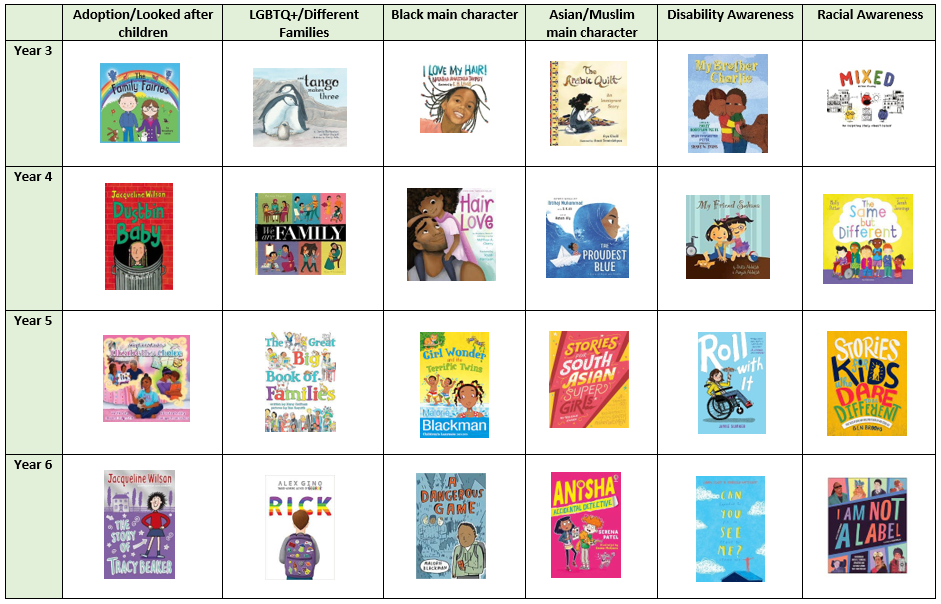
All the books listed below are available for pupils to read in the applicable class. Teachers also use these as the class text at the end of the school day as part of reading for enjoyment.
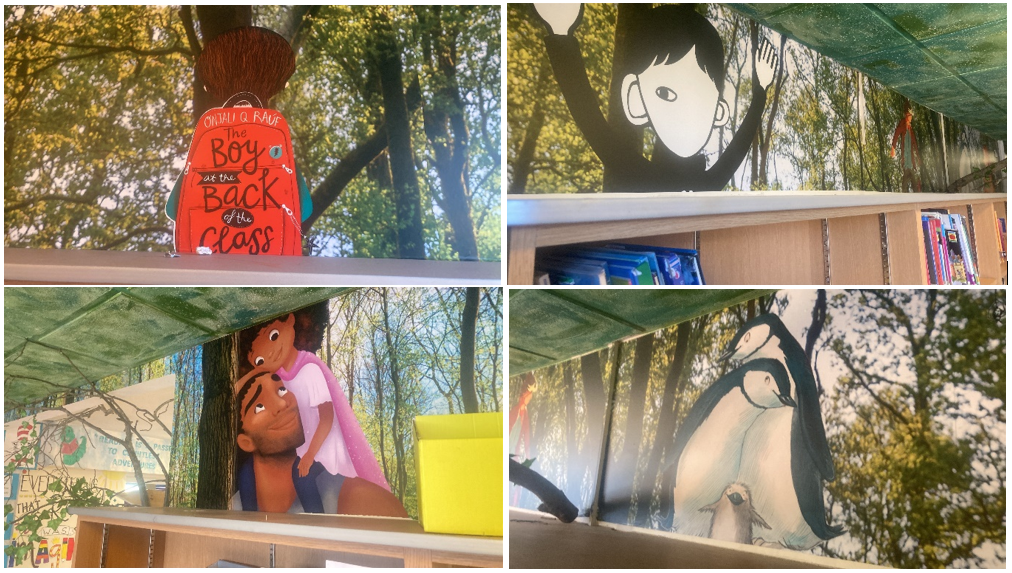
Our school library is also decorated to display and celebrate the diversity of book characters and to further promote pupils to read and enjoy books where the main characters do not reflect their own backgrounds.
As part of our curriculum, texts such as 'Journey to Jo'burg' furthers this understanding as the main characters do not live with their mother. This text also ensures we have cultural diversity within our curriculum and ensures our black African children can see themselves reflected within the curriculum.
Older year groups use the text 'Hidden figures' to celebrate the role of black women who helped win the space race. This also enriches our science curriculum. They also explore 'Boy at the back of the classroom' to gain an understanding of life in Syria and the challenges faced by refugees who have been relocated. Pupils also produce leaflets based on Colombia, linked to our chosen charity. Our oldest pupils study 'When the mountains roared' to develop their understanding of children living in a country different to that of their birth and to ensure our Indian children see themselves reflected within the curriculum. Children become culturally aware through the genre of rap, exploring the work of Christian Foley following on from a bespoke workshop. The London Eye mystery includes a child with Autistic Spectrum Disorder as the main protagonist, furthering pupils' understanding.
Skills progression
English
|
|
Prior Skills |
Year 3 |
Year 4 |
Year 5 |
Year 6 |
Future Skills |
|
Word Reading |
apply phonic knowledge and skills as the route to decode words
respond speedily with the correct sound to graphemes (letters or groups of letters) for all 40+ phonemes, including, where applicable, alternative sounds for graphemes
read accurately by blending sounds in unfamiliar words containing GPCs that have been taught
read common exception words, noting unusual correspondences between spelling and sound and where these occur in the word read words containing taught GPCs and –s, –es, –ing, –ed, –er and –est endings
read other words of more than one syllable that contain taught GPCs
read words with contractions [for example, I’m, I’ll, we’ll], and understand that the apostrophe represents the omitted letter(s)
read aloud accurately books that are consistent with their developing phonic knowledge and that do not require them to use other strategies to work out words re-read these books to build up their fluency and confidence in word reading.
read accurately by recognising alternative sounds for graphemes
read words containing common suffixes
read further common exception words, noting unusual correspondences between spelling and sound and where these occur in the word
read most words quickly and accurately, without overt sounding and blending, when they have been frequently encountered
read aloud books closely matched to their improving phonic knowledge, sounding out unfamiliar words accurately, automatically and without undue hesitation |
To apply their growing knowledge of root words, prefixes and suffixes (etymology and morphology) as listed in English Appendix 1, both to read aloud and to understand the meaning of new words they meet.
|
To continue to apply their growing knowledge of root words, prefixes and suffixes (etymology and morphology) as listed in English Appendix 1, both to read aloud and to understand the meaning of new words they meet.
|
To confidently apply their growing knowledge of root words, prefixes and suffixes (morphology and etymology), as listed in English Appendix 1, both to read aloud and to understand the meaning of new words that they meet. |
To independently apply their growing knowledge of root words, prefixes and suffixes (morphology and etymology), as listed in English Appendix 1, both to read aloud and to understand the meaning of new words that they meet. |
To read a wide range of fiction and non-fiction, including in particular whole books, short stories, poems and plays with a wide coverage of genres, historical periods, forms and authors. |
|
|
Prior Skills |
Year 3 |
Year 4 |
Year 5 |
Year 6 |
Future Skills |
|
Reading Comprehension |
develop pleasure in reading, motivation to read, vocabulary and understanding by: |
develop positive attitudes to reading and understanding of what they read by: |
maintain positive attitudes to reading and understanding of what they read by:
|
understand increasingly challenging texts through: |
||
|
listening to and discussing a wide range of poems, stories and non-fiction at a level beyond that at which they can read independently
being encouraged to link what they read or hear read to their own experiences
becoming very familiar with key stories, fairy stories and traditional tales, retelling them and considering their particular characteristics
recognising and joining in with predictable phrases
learning to appreciate rhymes and poems, and to recite some by heart discussing word meanings, linking new meanings to those already known discussing the sequence of events in books and how items of information are related
being introduced to non-fiction books that are structured in different ways
recognising simple recurring literary language in stories and poetry
discussing and clarifying the meanings of words, linking new meanings to known vocabulary
|
listening to and discussing a wide range of fiction, poetry, plays, non-fiction and reference books or textbooks
reading books that are structured in different ways and reading for a range of purposes |
continuing to read and discuss an increasingly wide range of fiction, poetry, plays, non-fiction and reference books or textbooks
reading books that are structured in different ways and reading for a range of purposes |
learning new vocabulary, relating it explicitly to known vocabulary and understanding it with the help of context and dictionaries
making inferences and referring to evidence in the text
knowing the purpose, audience for and context of the writing and drawing on this knowledge to support comprehension
checking their understanding to make sure that what they have read makes sense
|
|||
|
Marcy and the Riddle of the Sphinx James and the Giant Peach Around the World in 80 Days Wild Cities Here Comes Hercules How to grow your own dragon |
Nell and the Cave Bear The Boy with the Bronze Axe George’s Marvellous Medicine Journey to Jo’burg Revolt against the Romans The Explorer |
Hidden Figures The Boy at the Back of the Class Beowulf Journey to the River Sea A Midsummer Night’s Dream Nowhere Emporium |
Street Child The Last Bear When the Mountains Roared Treasure Island The Highwayman Skellig The London Eye Mystery |
|||
|
increasing their familiarity with a wide range of books, including fairy stories, myths and legends, and retelling some of these orally identifying themes and conventions in a wide range of books |
increasing their familiarity with a wide range of books, including myths and legends, and retelling some of these orally identifying themes and conventions in a wide range of books |
increasing their familiarity with a wide range of books, including legends, modern fiction, fiction from our literary heritage Beowulf, A Midsummer Night’s Dream |
increasing their familiarity with a wide range of books, including, traditional stories, modern fiction, fiction from our literary heritage, and books from other cultures and traditions Street Child, Treasure Island, When the Mountains Roared
|
|||
|
Beginning to prepare poems to read aloud and to perform, showing understanding through intonation, tone, volume and action
|
preparing poems and play scripts (year 4 Easter performance) to read aloud and to perform, showing understanding through intonation, tone, volume and action
|
preparing poems and plays (Midsummer Night’s Dream and Kennings) to read aloud and to perform, showing understanding through intonation, tone and volume so that the meaning is clear to an audience |
preparing poems and plays (Year 6 leavers performance) to read aloud and to perform, showing understanding through intonation, tone and volume so that the meaning is clear to an audience |
|||
|
discussing words and phrases that capture the reader’s interest and imagination |
recognising and discussing words and phrases that capture the reader’s interest and imagination |
Beginning to identify and discuss themes and conventions in and across a wide range of writing |
identifying and discussing themes and conventions in and across a wide range of writing |
|||
|
recognising some different forms of poetry – the sound collector
|
recognising some different forms of poetry – Please Mrs Butler |
learning a wider range of poetry by heart The British by Benjamin Zephaniah
|
learning a wider range of poetry by heart The Highwayman by Alfred Noyes
|
|||
|
|
Understand both the books they can already read accurately and fluently and those they listen to by: |
understand what they read, in books they can read independently, by: |
understand what they read by:
|
read critically through:
|
||
|
drawing on what they already know or on background information and vocabulary provided by the teacher
checking that the text makes sense to them as they read and correcting inaccurate reading
discussing the significance of the title and events
making inferences on the basis of what is being said and done
predicting what might happen on the basis of what has been read so far
participate in discussion about what is read to them, taking turns and listening to what others say
explain clearly their understanding of what is read to them. |
Beginning to check that the text makes sense to them, discussing their understanding and explaining the meaning of words in context |
Developing confidence in checking that the book makes sense to them, discussing their understanding and exploring the meaning of words in context |
Confidently checking that the book makes sense to them, discussing their understanding and exploring the meaning of words in context |
Independently checking that the book makes sense to them, discussing their understanding and exploring the meaning of words in context |
knowing how language, including figurative language, vocabulary choice, grammar, text structure and organisational features, presents meaning
recognising a range of poetic conventions and understanding how these have been used
studying setting, plot, and characterisation, and the effects of these
understanding how the work of dramatists is communicated effectively through performance and how alternative staging allows for different interpretations of a play
making critical comparisons across texts
studying a range of authors, including at least two authors in depth each year. |
|
|
asking simple questions to improve their understanding of a text |
asking a range of questions to improve their understanding
|
Asking a range of questions confidently to improve their understanding
|
Asking a range of detailed to improve their understanding
|
|||
|
Beginning to draw inferences such as inferring characters’ feelings, thoughts and motives from their actions, and beginning to justify inferences with evidence – using pictures to support |
drawing inferences such as inferring characters’ feelings, thoughts and motives from their actions, and justifying inferences with evidence |
Confidently drawing inferences such as inferring characters’ feelings, thoughts and motives from their actions, and justifying inferences with evidence |
drawing inferences and justifying them with evidence |
|||
|
predicting what might happen from details stated and implied |
predicting what might happen from details stated and implied, using prior knowledge to support |
predicting what might happen from details stated and implied supporting ideas with evidence from the text. |
predicting what might happen from details stated and implied, confirming and modifying predictions with new information |
|||
|
identifying main ideas drawn from one paragraph and summarising these
|
identifying main ideas drawn from more than one paragraph and summarising these
|
summarising the main ideas drawn from more than one paragraph, identifying key details that support the main ideas |
summarising the main ideas drawn from more than one paragraph, giving evidence that support the main ideas |
|||
|
Begin to identify how language, structure, and presentation contribute to meaning |
identifying how language, structure, and presentation contribute to meaning |
identifying with increasing confidence how language, structure and presentation contribute to meaning
|
Identifying how language, structure and presentation contribute to meaning giving explanations
|
|||
|
retrieve and record information from non-fiction
|
retrieve and record and begin to present information from non-fiction
|
retrieve, record and present information from non-fiction with increasing confidence |
retrieve, record and present information from non-fiction in a variety of ways |
|||
|
participate in discussion about both books that are read to them and those they can read for themselves, taking turns and listening to what others say. |
Confidently participate in discussion about both books that are read to them and those they can read for themselves, taking turns and listening to what others say. |
participate in discussions about books that are read to them and those they can read for themselves, building on their own and others’ ideas and challenging views courteously |
participate in meaningful discussions about books that are read to them and those they can read for themselves, building on their own and others’ ideas |
|||
|
|
|
|
explain and discuss their understanding of what they have read, maintaining a focus on the topic and using notes where necessary |
explain and discuss their understanding of what they have read, including through formal presentations and debates, maintaining a focus on the topic |
|
|
|
|
|
|
|
Begin to discuss and evaluate how authors use language, including figurative language, considering the impact on the reader |
discuss and evaluate how authors use language, including figurative language, considering the impact on the reader |
|
|
|
|
|
provide reasoned justifications for their views based on events and prior knowledge. |
Confidently provide reasoned justifications for their views |
|
|
|
Transcription - Handwriting |
Prior Skills |
Year 3 |
Year 4 |
Year 5 |
Year 6 |
Future Skills |
|
To handle equipment and tools effectively, including pencils for writing.
To write in print. |
To begin to use the diagonal and horizontal strokes needed to join letters and understand which letters, when adjacent to one another, are best left unjoined.
To show an increase in the legibility, consistency and quality of handwriting, e.g. by ensuring that down strokes of letters are parallel and equidistant; that lines of writing are spaced sufficiently so that the ascenders and descenders of letters do not touch. |
To confidently use the diagonal and horizontal strokes needed to join letters and understand which letters, when adjacent to one another, are best left unjoined.
To increase the legibility, consistency and quality of handwriting, e.g. by ensuring that down strokes of letters are parallel and equidistant; that lines of writing are spaced sufficiently so that the ascenders and descenders of letters do not touch. |
To demonstrate writing legibly, fluently, with increasing speed by: · Choosing which shape of letter to use when given choices and deciding whether or not to join specific letters. · Choosing the writing implement that is best suited for the task. |
To consistently write legibly, fluently, with increasing speed by: · Choosing which shape of letter to use when given choices and deciding whether or not to join specific letters. · Choosing the writing implement that is best suited for the task. |
|
|
Transcription Spellings |
Prior Skills |
Year 3 |
Year 4 |
Year 5 |
Year 6 |
Future Skills |
|
Spell:
name the letters of the alphabet:
add prefixes and suffixes:
apply simple spelling rules and guidance, as listed in English Appendix 1
write from memory simple sentences dictated by the teacher that include words using the GPCs and common exception words taught so far
add suffixes to spell longer words, including –ment, –ness, –ful, –less, –ly
apply spelling rules and guidance, as listed in English Appendix 1
write from memory simple sentences dictated by the teacher that include words using the GPCs, common exception words and punctuation taught so far |
use further prefixes and suffixes and understand how to add them (English Appendix 1) super, in, un, dis, mis
|
use further prefixes and suffixes and understand how to add them (English Appendix 1) under, sub, im, il, ir |
use further prefixes and suffixes and understand the guidance for adding them. Using hyphen for prefixes re |
use further prefixes and suffixes and understand the guidance for adding them. Using hyphen for prefixes co |
apply the spelling patterns and rules set out in English Appendix 1 to the key stage 1 and 2 programmes of study for English |
|
|
spell further homophones
|
|
continue to distinguish between homophones and other words which are often confused
|
|
|||
|
spell words that are often misspelt (English Appendix 1)
|
|
spell some words with ‘silent’ letters [for example, knight, psalm, solemn]
|
|
|||
|
place the possessive apostrophe accurately in words with regular plurals
|
place the possessive apostrophe accurately in words with regular and irregular plurals
|
Begin to use knowledge of morphology and etymology in spelling and understand that the spelling of some words needs to be learnt specifically, as listed in English Appendix 1
|
use knowledge of morphology and etymology in spelling and understand that the spelling of some words needs to be learnt specifically, as listed in English Appendix 1
|
|||
|
use the first two or three letters of a word to check its spelling in a dictionary
|
Independently use the first two or three letters of a word to check its spelling in a dictionary
|
use the first three or four letters of a word to check spelling, meaning or both of these in a dictionary
|
Confidently and independently use the first three or four letters of a word to check spelling, meaning or both of these in a dictionary |
|||
|
write from memory simple sentences, dictated by the teacher, that include words and punctuation taught so far. |
Confidently write from memory simple sentences, dictated by the teacher, that include words and punctuation taught so far. |
use a thesaurus to find synonyms and antonyms. |
Independently use a thesaurus to find appropriate synonyms and antonyms. |
|
|
Prior Skills |
Year 3 |
Year 4 |
Year 5 |
Year 6 |
Future Skills |
|
Writing Composition |
Plan writing |
Plan writing by: |
Plan writing by: |
Write accurately, fluently, effectively Write for a wide range of purposes and audiences
summarise and organising material, and supporting ideas and arguments with any necessary factual detail
apply their growing knowledge of vocabulary, grammar and text structure to their writing and selecting the appropriate form
draw on knowledge of literary and rhetorical devices from their reading and listening to enhance the impact of their writing |
||
|
Say out loud what they are going to write about.
|
As a class, discuss writing similar to that which they are planning to write in order to understand and learn from its structure, vocabulary and grammar discussing and recording ideas
|
In group/partner talk, discuss writing similar to that which they are planning to write in order to understand and learn from its structure, vocabulary and grammar discussing and recording ideas
|
Identifying the audience for and purpose of the writing, selecting the appropriate form and using other similar writing as models for their own noting and developing initial ideas, drawing on reading and research where necessary.
|
Confidently identify the audience for and purpose of the writing, selecting the appropriate form and using other similar writing as models for their own noting and developing initial ideas, drawing on reading and research where necessary.
|
||
|
Plan or say out loud what they are going to write about. Write idea and/or key words including new vocab.
|
|
|
Begin to consider how authors have developed characters and settings in what pupils have read, listened to or seen performed, when writing narratives.
|
Considering how authors have developed characters and settings in what pupils have read, listened to or seen performed, when writing narratives
|
||
|
Drafting & writing |
Draft and write by |
Draft and write by |
plan, draft, edit and proof-read: |
|||
|
|
Compose a sentence orally before writing. |
composing and rehearsing sentences orally (including dialogue) |
Confidently composing and rehearsing sentences orally (including dialogue) |
Begin to select appropriate grammar and vocabulary, understanding how such choices can change and enhance meaning |
selecting appropriate grammar and vocabulary, understanding how such choices can change and enhance meaning |
consider how their writing reflects the audiences and purposes for which it was intended
amend the vocabulary, grammar and structure of their writing to improve its coherence and overall effectiveness |
|
Sequence sentences to form short narratives.
|
gradually building a varied and rich vocabulary and an increasing range of sentence structures |
building a varied and rich vocabulary and an increasing range of sentence structures |
in narratives, describing settings, characters and atmosphere and begin to integrate dialogue to convey character and advance the action |
in narratives, describing settings, characters and atmosphere and integrate dialogue to convey character and advance the action |
||
|
Encapsulate what they want to say, sentence by sentence.
|
Begin to organise paragraphs around a theme in narratives |
organising paragraphs around a theme in narratives |
précising longer passages with growing confidence |
précising longer passages |
||
|
|
Begin to create settings, characters and plot in non-narrative material |
create settings, characters and plot in non-narrative material |
using a wide range of devices to build cohesion within and across paragraphs |
Confidently using a wide range of devices to build cohesion within and across paragraphs |
||
|
|
Begin to use simple organisational devices [for example, headings and subheadings |
using simple organisational devices [for example, headings and subheadings |
Begin to use further organisational and presentational devices to structure text and to guide the reader [for example, headings, bullet points, underlining] |
using further organisational and presentational devices to structure text and to guide the reader [for example, headings, bullet points, underlining] |
||
|
Evaluate and edit |
Evaluate and edit by: |
Evaluate and edit by: |
|
|||
|
Evaluating their own writing with the teacher or other pupils.
|
Begin to assess the effectiveness of their own and others’ writing and suggesting improvements proposing changes to grammar and vocabulary to improve consistency, including the accurate use of pronouns in sentences |
Develop assessing the effectiveness of their own and others’ writing and suggesting improvements proposing changes to grammar and vocabulary to improve consistency, including the accurate use of pronouns in sentences |
Assess the effectiveness of their own and others’ writing proposing changes to vocabulary, grammar and punctuation to enhance effects and clarify meaning. |
With growing independence, Assess the effectiveness of their own and others’ writing proposing changes to vocabulary, grammar and punctuation to enhance effects and clarify meaning. |
||
|
Rereading to check it makes sense and that verbs to indicate time are used correctly and consistently, including verbs in the continuous form.
|
read aloud their own writing, to a group using appropriate intonation and controlling the tone and volume so that the meaning is clear |
read aloud their own writing, to the whole class, using appropriate intonation and controlling the tone and volume so that the meaning is clear |
ensuring the consistent and correct use of tense throughout a piece of writing.
|
Consistently ensuring the consistent and correct use of tense throughout a piece of writing.
|
||
|
|
Discuss what they have written with the teacher or other pupils. Read aloud their writing clearly enough to be heard by their peers and the teacher.
|
|
|
Beginning to distinguish between the language of speech and writing and choosing the appropriate register
|
distinguishing between the language of speech and writing and choosing the appropriate register
|
|
|
Proof read to check for errors in spelling, grammar and punctuation. |
Begin to proof-read for spelling and punctuation errors (. CL ! ?) |
proof-read for spelling and punctuation errors (. CL , “ “) |
With decreasing support, proof-read for spelling and punctuation errors (“” ;) |
Independently proof-read for spelling and punctuation errors (“” … ; : -) |
|
|
|
Vocabulary, Grammar and Punctuation |
Prior Skills |
Year 3 |
Year 4 |
Year 5 |
Year 6 |
Future Skills |
|
Word Level |
Word Level |
Consolidation |
||||
|
To recognise prefixes and suffixes in forming verbs, nouns and adjectives.
|
To understand the formation of nouns using a range of prefixes.
To understand the use of the forms a or an according to whether the next word begins with a consonant or a vowel.
To recognise word families based on common words, showing how words are related in form and meaning. E.g. solve/solution. |
To understand the grammatical difference between plural and possessive –s.
To recognise Standard English forms for verb inflections instead of local spoken forms e.g. we were/we was. |
To convert nouns or adjectives into verbs using suffixes e.g. ‘-ate’, ‘-ise’, ‘- ify’ Verb prefixes e.g. dis-, de-, mis-, over-, re.
|
To understand the difference between structures typical of informal speech and structures appropriate for formal speech and writing e.g. find out/discover, ask for/request.
To know how words are related by meaning as synonyms and antonyms e.g. big, large, little.
|
Extend and apply the grammatical knowledge set out in English Appendix 2 to the key stage 1 and 2 programmes of study to analyse more challenging texts
study the effectiveness and impact of the grammatical features of the texts they read
draw on new vocabulary and grammatical constructions from their reading and listening, and using these consciously in their writing and speech to achieve particular effects
know and understand the differences between spoken and written language, including differences associated with formal and informal registers, and between Standard English and other varieties of English
use Standard English confidently in their own writing and speech |
|
|
Sentence |
Sentence |
|||||
|
To join sentences using and.
To recognise sentence types.
To use expanded noun phrases.
To use subordinating and coordinating conjunctions.
|
To express time, place and cause using conjunctions adverbs or prepositions.
|
To use noun phrases expanded by the addition of modifying adjectives, nouns and preposition phrases (e.g. the teacher expanded to: the strict maths teacher with curly hair)
To use fronted adverbials.
|
To recognise relative clauses beginning with who, which, where, when, whose, that, or an omitted relative pronoun To indicate degrees of possibility using adverbs [for example, perhaps, surely] or modal verbs [for example, might, should, will, must]
|
To use of the passive to affect the presentation of information in a sentence.
To recognise the difference between structures typical of informal speech and structures appropriate for formal speech and writing [for example, the use of question tags or the use of subjunctive forms in some very formal writing and speech] |
||
|
Text Structure |
Text Structure |
|||||
|
To sequence sentences to form short narratives.
To use correct choice and consistent use of present tense and past tense throughout writing.
To use the progressive form of verbs in the present and past tense to mark actions in progress [for example, she is drumming, he was shouting]
|
To be introduced to paragraphs as a way to group related material.
To use headings and sub-headings to aid presentation.
To recognise the use of the present perfect form of verbs instead of the simple past [for example, He has gone out to play contrasted with He went out to play]
|
To use paragraphs to organise ideas around a theme.
To appropriately choose pronouns or nouns within and across sentences to aid cohesion and avoid repetition.
|
To use devices to build cohesion within a paragraph [for example, then, after that, this, firstly]
To link ideas across paragraphs using adverbials of time [for example, later], place [for example, nearby] and number [for example, secondly] or tense choices [for example, he had seen her before
|
To link ideas across paragraphs using a wider range of cohesive devices: repetition of a word or phrase, grammatical connections [for example, the use of adverbials such as on the other hand, in contrast, or as a consequence], and ellipsis
To use a range of layout devices [for example, headings, sub-headings, columns, bullets, or tables, to structure text] |
||
|
Punctuation |
Punctuation |
|
||||
|
|
To separate words with spaces.
To be introduced to capital letters, full stops, question marks and exclamation marks to demarcate sentences To use capital letters for names and for the personal pronoun I
To use capital letters, full stops, question marks and exclamation marks to demarcate sentences.
To use commas to separate items in a list.
To use apostrophes to mark where letters are missing in spelling and to mark singular possession in nouns [for example, the girl’s name] |
To be introduced to inverted commas to punctuate direct speech.
|
To use inverted commas and other punctuation to indicate direct speech [for example, a comma after the reporting clause; end punctuation within inverted commas: The conductor shouted, “Sit down!”]
To use apostrophes to mark plural possession [for example, the girl’s name, the girls’ names]
To use commas after fronted adverbials.
|
To use brackets, dashes or commas to indicate parenthesis
To use commas to clarify meaning or avoid ambiguity.
|
To use semi-colon, colon and dash to mark the boundary between independent clauses [for example, It’s raining; I’m fed up]
To use colons to introduce a list and use of semi-colons within lists.
To punctuate bullet points to list information.
To know how hyphens can be used to avoid ambiguity [for example, man eating shark versus man-eating shark, or recover versus re-cover]
|
|
French
|
Speaking and Pronunciation |
Prior Skills |
Year 3 |
Year 4 |
Year 5 |
Year 6 |
Future Skills |
|
|
To ask and/or answer simple questions.
|
To recognise and answer simple questions which involve personal information.
|
To form a question in order to ask for information.
|
To develop extended sentences, for example to justify a fact or opinion.
|
To speak coherently and confidently, with increasingly accurate pronunciation and intonation
To initiate and develop conversations, coping with unfamiliar language and unexpected responses, making use of important social conventions such as formal modes of address |
|
|
To form simple statements with information including the negative.
|
To begin to form opinion phrases.
|
To present factual information in extending sentences including justification.
|
To plan, ask and answer extended questions.
|
|||
|
To practise speaking with a partner.
|
To begin to use conversational phrases for purposeful dialogue.
|
To rehearse and recycle extended sentences orally.
|
To engage in conversation and transactional language.
|
|||
|
To use short phrases to give information.
|
To use a model to form a spoken sentence.
|
To plan and present a short descriptive text.
|
To plan and present a short descriptive text with growing fluency.
|
|||
|
To begin to adapt phrases from rhyme and song.
|
To speak in full sentences using known vocabulary.
|
To use intonation and gesture to differentiate between statements and questions.
|
To modify, express and compare opinions.
|
|||
|
To listen and repeat key phonemes with care.
|
To compare sounds and spelling patterns with English.
|
To make realistic attempts at pronunciation of new, unknown vocabulary.
|
To discuss strategies for remembering and applying pronunciation rules.
|
|||
|
To repeat short phrases accurately, including liaison of final consonant before vowel.
|
To listen and repeat further key phonemes with care.
|
To listen and repeat key phonemes with care applying pronunciation rules.
|
To speak and read aloud with increasing confidence and fluency.
|
|||
|
To introduce self to a partner with simple phrases. |
To rehearse and perform a short presentation.
|
To adapt a story and retell to the class.
|
To give a presentation drawing upon learning from a number of previous topics. |
|||
|
|
|
|
To choose appropriate adjectives from a wider range of adjectives. |
To use adjectives with correct placement and agreement. |
To recognise and use a wide range of descriptive patterns.
|
|
|
Listening |
Prior Skills |
Year 3 |
Year 4 |
Year 5 |
Year 6 |
Future Skills |
|
|
To listen and respond to single words and short phrases.
|
To listen and select information |
To listen and gist information from an extended text using language detective skills such as cognates. |
To use prepositions to indicate the location of objects relative to something.
|
To listen to a variety of forms of spoken language to obtain information and respond appropriately |
|
|
To follow verbal instructions in French.
|
To use language detective skills to decode vocabulary.
|
To listen and follow the sequence of a story, song or text including some unfamiliar language. |
To recognise present and near future tense sentences (using aller + infinitive).
|
|||
|
To respond to objects or images with a phrase or other verbal response.
|
To identify item by colour and other adjectives.
|
To match unknown written words to new spoken words.
|
To understand directional language and phrases and prepositions to describe how to get to places. E.G., the route to school. |
|||
|
To listen and identify key words in rhyme and songs and join in.
|
To listen to songs, joining in with songs and noticing sound patterns.
|
To recognise blends of sounds and selecting words to recognise common spelling patterns. |
To listen to stories, songs or texts in French. |
|||
|
To listen and notice rhyming words. |
To notice and begin to predict key word patterns and spellings. |
To notice and predict key word patterns and spellings. |
To recall and perform an extended song or rhyme. |
|
Reading and Writing |
Prior Skills |
Year 3 |
Year 4 |
Year 5 |
Year 6 |
Future Skills |
|
|
To recognise some familiar words in written form.
|
To notice and discuss cognates and begin to identify language detective strategies. |
To use a range of language detective strategies to decode new vocabulary including context and text type. |
To make increasingly accurate attempts to read unfamiliar words or phrases.
|
To read and show comprehension of original and adapted materials from a range of different sources, understanding the purpose, important ideas and details, and provide an accurate English translation of short, suitable material.
To read literary texts in the language [such as stories, songs, poems and letters], to stimulate ideas, develop creative expression and expand.
To understand the language and culture of transcribed words and short sentences that they hear with increasing accuracy.
To write prose using an increasingly wide range of grammar and vocabulary, write creatively to express their own ideas and opinions, and translate short written text accurately into the foreign language. |
|
|
To read aloud some words from simple songs, stories and rhymes. |
To follow a short text or rhyme, listen and read at the same time.
|
To read and adapt a range of different format short texts.
|
To read and use language detective skills to assess meaning including sentence structure. |
|||
|
To begin to develop dictionary skills.
|
To become familiar with format, layout and simple use of a bilingual dictionary to find the meaning of unknown words and check the spelling of unfamiliar words. |
To confidently use a bilingual dictionary to find the meaning of unknown words and check the spelling of unfamiliar words.
|
To use a bilingual dictionary to select alternative vocabulary for sentence building.
|
|||
|
To identify cognates and near cognates.
|
To use cognates and near cognates along with other detective skills to gist information. |
To gist information from an extended text.
|
To construct a short text on a familiar topic.
|
|||
|
To recall and write simple words from memory. |
To select and write short words and phrases.
|
To use contextual clues and cues to gist and make predictions about meanings. |
To read and respond to an extract from a story, an email message or song. |
|||
|
|
|
To experiment with simple writing, copying with accuracy. |
To make short phrases or sentences using words cards. |
To write a short text using word and phrase cards to model or scaffold. |
To read short authentic texts for enjoyment or information. |
|
|
|
To use adapted phrases to describe an object or person. |
To use different adjectives, with correct positioning and agreement. |
To use a wide range of descriptive phrases. |
|||
|
|
|
To use existing knowledge of vocabulary and phrases to create sentences. |
To choose words, phrases and sentences and writing as a text of caption. |
|
Grammar |
Prior Skills |
Year 3 |
Year 4 |
Year 5 |
Year 6 |
Future Skills |
|
|
To begin to recognise gender of nouns, definite and indefinite article.
|
To use indefinite article in the plural form.
|
To correctly use definite and indefinite articles depending on gender and number of noun and including partitive ‘some’. |
To independently use definite and indefinite articles depending on gender and number of noun and including partitive ‘some’. |
To identify and use tenses or other structures which convey the present, past, and future as appropriate to the language being studied.
To use and manipulate a variety of key grammatical structures and patterns, including voices and moods, as appropriate.
To develop and use a wide-ranging and deepening vocabulary that goes beyond their immediate needs and interests. To use accurate grammar, spelling and punctuation. |
|
|
To identify plurals of nouns.
|
To recognise and use possessive adjective ‘my’ and pronouns he/she/it |
|
|
|||
|
To recognise adjectives and placement relative to the noun.
|
To recognise and begin to apply rules for placement and agreement pf adjectives. |
To apply placement and agreement rules for adjectives.
|
To accurately apply placement and agreement rules for adjectives.
|
|||
|
To begin to understand that verbs have patterns.
|
To recognise verb patterns.
|
To recognise and apply verb endings from present regular ‘er’ verbs.
To explore verbs in infinitive form. |
To confidently recognise and apply verb endings for present regular ‘er’ verbs.
|
|||
|
To notice the negative form.
|
To recognise and use the negative form.
|
To learn and use some high frequency irregular verbs e.g., to have, to be, to go. |
To learn and use some common irregular verbs, e.g., Faire – ‘to make/do. |
|||
|
To begin to use prepositions.
|
To use prepositions.
|
To use comparative language. |
To identify word classes within a sentence. |
|||
|
|
To make comparisons of word order in French and English. |
To begin to understand how word order differs between French and English.
|
To understand how word order differs between French and English.
|
|
Intercltural Understanding |
Prior Skills |
Year 3 |
Year 4 |
Year 5 |
Year 6 |
Future Skills |
|
|
To recognise that different languages are spoken in the community/world. |
To identify some French speaking countries. |
To identify and locate other countries in the world where French is spoken. |
To name other countries in the world where French is spoken.
|
|
|
|
To show awareness of the capital and identifying some key cultural landmarks. |
To compare schools and celebrations between France and England.
|
To compare geographical features and climates of different French-speaking countries. |
To learn about France’s sporting culture and events.
|
|||
|
To recognise cultural similarities and differences between customs and tradition in France and England.
|
To recognise and use the Euro currency.
|
To recognise and use the Euro currency with confidence.
|
To ask questions and make insightful commentary on cultural differences, including some understanding of stereotype. |
.JPG)